
How to Use Dinosaur Toys to Spark an Interest in Science Careers | From Play to Profession
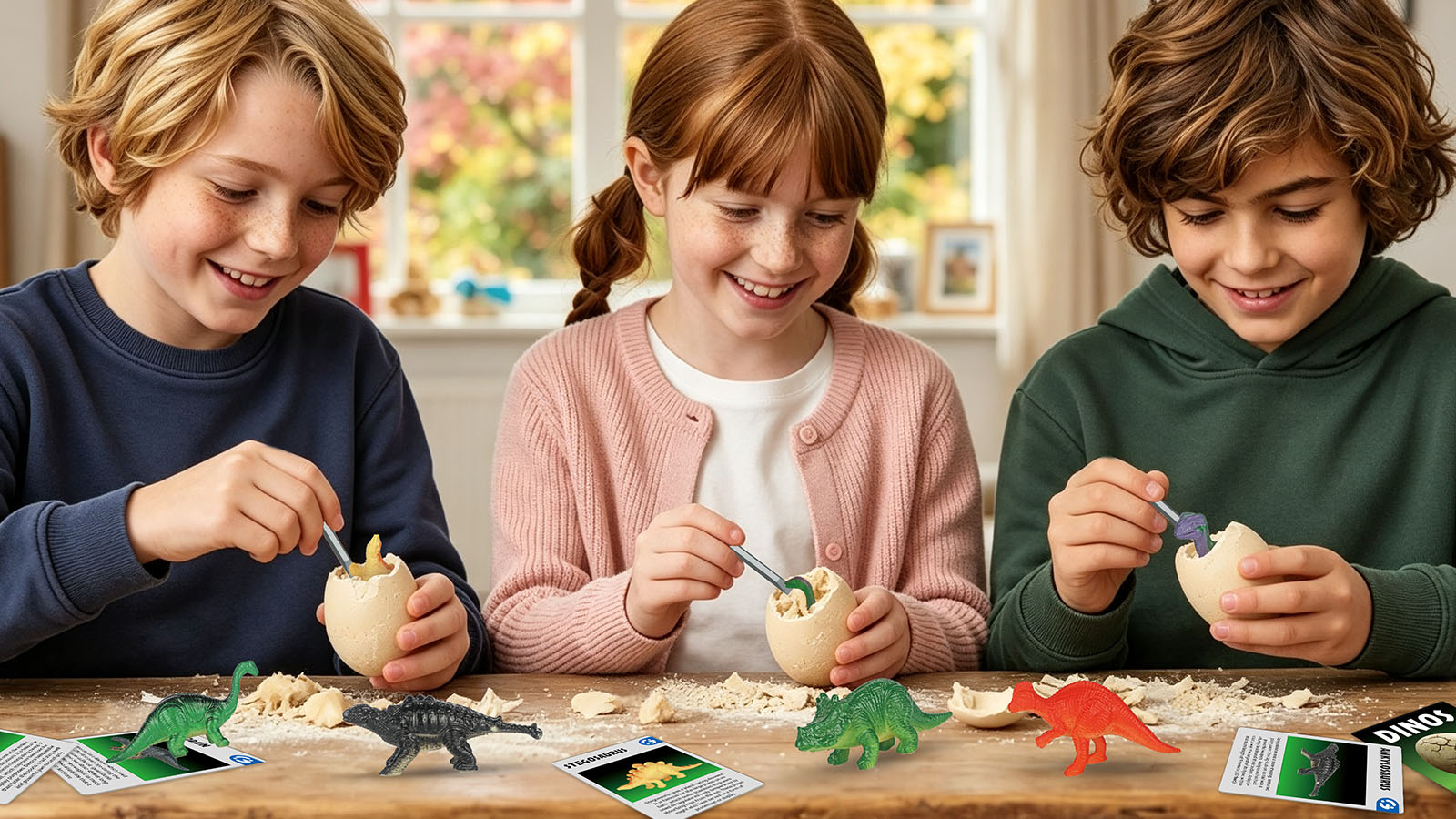
Dinosaur toys can do more than help children remember names. Used the right way, they give kids something they can actually investigate. Start with 5–8 figures, a ruler, and a notebook. Children can compare body shapes, work out model scale, sort species, record a dig, build habitats, and explain what the evidence seems to show. If you use an excavation kit, always follow its age label. Many digging kits are made for children aged 6 and older.
That kind of play touches several real science careers, including paleontology, geology, biology, biomechanics, museum science, scientific illustration, GIS, and science communication. The National Academies describes eight core science and engineering practices for K–12 students. They include asking questions, using models, carrying out investigations, analyzing data, using mathematics, explaining results, arguing from evidence, and communicating information.[1]
Start With a Question the Child Can Investigate
Put five or six dinosaur figures on a table. Give the child a minute to look at them before anyone starts naming species.
Ask what they notice first. Maybe one has large teeth. Another has horns. One walks on two legs while another has four. They may notice neck length, tail shape, plates, crests, or very different body proportions.
Now choose one question that cannot be answered just by looking at the toy. What could tooth shape tell us about diet? Did these two species live at the same time? Does a long neck automatically mean an animal ate from tall trees?
Young children only need one question. Older children can divide a notebook page into three simple columns: What I See, What I Think, and What I Need to Check.
This works better than turning dinosaur play into a quiz. Children still get room to explore things in their own way. The American Academy of Pediatrics notes that developmentally appropriate play can support cognitive, language, social-emotional, and self-regulation skills.[2]
Practice Observation Before Explaining What a Feature Means
You do not need a huge dinosaur collection for this. Five to eight clearly different figures are plenty.
Ask the child to describe what each model actually shows. Do not explain the feature yet. The point is to separate what they can see from what they think it means.
| Dinosaur | Direct Observation | Question That Needs Evidence |
|---|---|---|
| Triceratops | Three horns and a large frill | What functions did the horns and frill serve? |
| Tyrannosaurus | Large skull, large teeth, short forelimbs | How did it obtain food? |
| Stegosaurus | Large back plates and tail spikes | What were the plates used for? |
For example, “this model has three horns” is an observation. “Those horns were only used to fight predators” is a much bigger claim. That second statement needs evidence.
Paleontologists work in much the same way on a far more advanced level. They study fossils together with anatomy, geology, locality records, and collection data to understand extinct animals and their environments.[3] At home, the rule is simple: describe first, explain later.

Use Sorting to Introduce Scientific Classification
Give the child 6–10 prehistoric animal figures and let them decide how to sort them.
The first rule can be very simple. Two legs or four? Long neck or short neck? Armor or no armor?
Then mix everything up and try again with a new rule. Older children can sort by diet, geologic period, discovery region, or anatomical features instead of appearance alone.
A jumbo dinosaur egg dig kit containing 12 prehistoric figures gives children enough models to repeat this activity several times after the excavation is over. It also creates a useful classification puzzle. Pterodactyl is included with the dinosaur figures, but pterosaurs were flying reptiles, not dinosaurs.
Ask the child where the pterosaur should go and why. That small mistake in a toy set can actually become a better science lesson than simply assuming everything with a prehistoric look belongs in the same group.
Turn a Dinosaur Dig Into a Recorded Investigation
With an age-appropriate excavation kit, do not rush straight into digging. Let the child inspect the block first.
They can write down what the surface looks like, whether there are cracks, and what they think might be inside. As pieces appear, record what changed.
| Stage | What to Record |
|---|---|
| Before digging | Surface texture, visible cracks, first prediction |
| First exposure | Shape, color, approximate size |
| Further exposure | New features and revised identification |
| After removal | Final identification, measurement, sketch |
One point matters here: the depth or position of a toy inside a commercial digging block has no geological meaning. The manufacturer placed it there during production. Children can still record the position for practice, but it should not be treated like a fossil found inside a real rock layer.
Real paleontology is different. Geological setting can matter enormously. The fossil’s location, surrounding sediment, rock formation, orientation, and nearby finds can all affect how scientists interpret it.[3]
After digging, try reconstruction. The Triceratops Skeleton Excavation Kit, for example, contains 11 skeleton pieces and is labeled for ages 6 and up. Before putting it together, ask the child which pieces might be limbs, skull parts, or other structures just from their shapes.
You can run a different activity with a T. rex claw and Ankylosaurus spine replica excavation. Measure the two replicas first. Sketch their outlines. Compare their shapes, then check the supplied identification.
The paleontology activity guide takes this idea further with inspection, excavation, recording, comparison, and follow-up research.
Use Dinosaur Models to Teach Scale and Measurement
Dinosaur figures are not always made to the same scale. That sounds like a flaw, but it gives children a good reason to use measurement and ratios.
Imagine a toy is 30 cm long and the real animal is estimated to have been 9 m long.
9 m = 900 cm
900 ÷ 30 = 30
So the toy is roughly 1:30 scale.
Now measure another figure and do the same calculation. Two toys may look almost the same size on a shelf even though the real animals differed greatly in length. If so, the models are probably using different scales.
| Model | Toy Length | Estimated Real Length | Approximate Scale |
|---|---|---|---|
| Example A | 30 cm | 9 m | 1:30 |
| Example B | Measure | Research | Calculate |
| Example C | Measure | Research | Calculate |
This also gives children a useful reminder about models. A toy’s size, color, pose, or proportions should not automatically be treated as scientifically exact.
Separate Strong Evidence From Reconstruction
Show the child an image of a dinosaur skeleton and ask them to draw what the living animal might have looked like.
Use two colors. One color can mark features strongly supported by the skeleton. The other can mark details that involve more interpretation.
Bones can tell scientists quite a lot about body proportions, joints, teeth, and some muscle attachment areas. Exact skin colors, many soft-tissue features, and certain behaviors are much harder to pin down.
The American Museum of Natural History uses fossil anatomy to investigate dinosaur feeding, movement, defense, and other biological functions.[4]
Older children can compare an old dinosaur reconstruction with a modern one. Ask what changed. Was a new fossil discovered? Did scientists find better anatomical evidence? Did imaging improve? Or did researchers simply interpret the same evidence differently?
Use a Timeline to Show That Dinosaurs Did Not All Live Together
Put a Stegosaurus next to a Tyrannosaurus and ask one simple question: could these two animals really have met?
For younger children, make a paper timeline with three sections:
- Triassic;
- Jurassic;
- Cretaceous.
Place several figures in the right section. With older children, add approximate dates and compare the time gaps between different species.
The end-Cretaceous mass extinction happened about 66 million years ago and wiped out all non-avian dinosaurs. Birds survived and are the living dinosaur lineage today.[5]
If the child starts asking more about rocks, fossils, and geological time than the dinosaurs themselves, move into broader hands-on Earth science activities. Rocks, minerals, erosion, fossils, plate tectonics, and planetary science all connect naturally from there.
Build a Small Prehistoric Ecosystem
Put one dinosaur in an empty box and ask what it would need around it to survive.
Add water. Add plants. Think about prey, predators, or competitors. Use cardboard, stones, or modeling material for simple terrain.
Once the habitat is built, change one thing. Remove some plants. Take away a water source. Change the temperature. Add another herbivore that needs similar food.
Then ask what might be affected first. The answer does not need to be perfect. The useful part is thinking about connections inside a system.
After that, check one part of the habitat using a museum source. Did that dinosaur live around forests, floodplains, deserts, or coastal environments? What other plants and animals have been found in the same geological formation?
Smithsonian fossil collections include dinosaurs alongside fossil plants, insects, marine organisms, and many other remains. Scientists use this wider evidence to understand ancient ecosystems and environmental change.[6]
Use Claims, Evidence, and Uncertainty in Dinosaur Debates
Children love questions such as which dinosaur was faster, stronger, or better defended. Instead of shutting that conversation down, use it.
Ask them to separate the claim from the evidence.
| Part | Example |
|---|---|
| Claim | This animal was probably adapted to eating meat. |
| Evidence | Its teeth have features associated with processing animal tissue. |
| Uncertainty | A plastic toy cannot establish diet; fossil anatomy must be checked. |
Argument from evidence is one of the eight science and engineering practices identified by the National Academies.[1]
For older children, ask them to find more than one independent piece of evidence when possible. And if two reliable sources disagree, keep the disagreement. Science does not always give a neat answer on the first try.
Let the Child Build a Small Museum Exhibit
Choose 6–10 dinosaur figures or fossil replicas and turn a table or shelf into a mini museum.
Each label can include the species or specimen name, geologic period, diet, two visible features, one interpretation, and one question that is still uncertain.
Then decide how the collection should be arranged. By period? Diet? Anatomy? Discovery location? Rearranging the same objects changes the story visitors get from the exhibit.
The American Museum of Natural History says its fourth-floor fossil halls contain about 600 fossil specimens, including roughly 100 dinosaur specimens. Around 85% of the specimens on display are actual fossils rather than casts or reproductions.[7]
Finish with a short museum tour. Ask the child to explain three specimens, make one comparison, and point out one question the models cannot answer.
Match the Activity to the Child’s Age
The ranges below are practical starting points, not strict developmental rules. Some children will stay interested longer. Others will be done sooner. Stop before the activity starts feeling like homework.
| Age | Suggested Starting Length | Good Starting Materials | Main Task |
|---|---|---|---|
| 3–5 | 10–15 minutes | 3–5 large, age-appropriate figures | Observe, compare, describe |
| 6–8 | 20–30 minutes | Figures, ruler, notebook, age-appropriate dig kit | Sort, measure, predict, record |
| 9–12 | 30–45 minutes | Models, reference material, simple data tables | Analyze evidence, calculate scale, research |
| 13+ | 45 minutes or longer when engaged | Museum databases, maps, digital models | Independent research and analysis |
For preschool children, stay with things they can see: horns, plates, body size, and number of legs. Avoid excavation kits unless the manufacturer clearly says the product is suitable for that age.
Children aged 6–8 can start using rulers and keeping simple records. A small science discovery corner at home can hold a notebook, ruler, magnifying glass, specimen tray, and whatever project they are currently working on. It does not need to take over an entire room.
For ages 9–12, bring in ratios, geological timelines, graphs, source comparison, and questions that may have more than one reasonable answer. Teenagers can go further with museum collections, geological maps, 3D modeling, university outreach, and accessible scientific papers.
Match the Child’s Favorite Activity With a Science Career
A child who loves dinosaurs does not automatically want to become a paleontologist.
Watch what they keep doing when nobody tells them what to do. That is often more revealing than asking what job they want someday.
| If the Child Keeps Doing This | What It May Show Interest In | Related Fields |
|---|---|---|
| Measures every model and compares ratios | Quantitative comparison and mechanics | Biomechanics, engineering, data analysis |
| Reassembles skeletons and studies body parts | Anatomy and structure | Paleontology, zoology, evolutionary biology |
| Asks where fossils came from | Place, rocks, and geological context | Geology, stratigraphy, GIS |
| Draws or digitally reconstructs dinosaurs | Visual interpretation of scientific evidence | Scientific illustration, 3D visualization |
| Builds detailed prehistoric habitats | Relationships between organisms and environments | Ecology, environmental science |
| Organizes collections and labels specimens | Collections and information management | Museum curation, collections management |
| Explains discoveries to other people | Communication and teaching | Museum education, science writing, outreach |
Paleontology itself is also much broader than dinosaur research. Paleontologists study fossils inside geological formations to learn about the evolution of plants and animals and the geological history of Earth.[8]
The U.S. Bureau of Labor Statistics places paleontologists within the broader geoscientist occupation. Geoscientists held about 25,400 U.S. jobs in 2025, and employment is projected to grow 5% from 2025 to 2035. Those numbers cover all geoscientists, not paleontologists alone. A bachelor’s degree is typically needed to enter the occupation, while some positions favor candidates with a master’s or doctoral degree.[8]
Try a Four-Week Dinosaur Science Project
If a child keeps coming back to dinosaurs, try staying with one question for a few weeks instead of jumping to a new topic every day.
| Week | Task | Output |
|---|---|---|
| 1 | Observe and measure several models | Comparison table |
| 2 | Complete an excavation or skeleton reconstruction | Observation record and sketch |
| 3 | Research one narrow question | Evidence notes and remaining uncertainty |
| 4 | Create a small exhibit or explanation | Short presentation |
A topic such as “Everything about T. rex” usually turns into a pile of facts. A smaller question is easier to investigate properly.
- What can tooth shape tell us about diet?
- How do scientists estimate the size of an extinct animal?
- What information can footprints provide that bones cannot?
- Why have some dinosaur reconstructions changed?
Teachers can use the same approach with a group excavation. The dinosaur egg dig classroom guide combines prediction, controlled digging, recording, measurement, and explanation instead of making the activity a race to uncover the toy first.
How to Tell When Dinosaur Interest Is Becoming Scientific Curiosity
Knowing dozens of dinosaur names shows memory and interest. The questions a child asks tell you more about how they are starting to think.
| Fact Question | Investigation Question |
|---|---|
| What dinosaur is this? | Which features help us identify it? |
| Which one is biggest? | How could we estimate its real size? |
| What did it eat? | What evidence tells scientists what it ate? |
| What color was it? | What evidence could preserve information about color? |
| Who would win? | What would we need to compare before answering? |
Behavior matters too. A child might measure something twice because the first result looks wrong. They may change a sorting rule that does not work. They might notice two sources disagree or return to an unfinished skeleton without anyone reminding them.
Those moments are worth more than firing four trivia questions at them in a row. Pick one problem they can measure, test, research, or explain and see where it goes.
Use Safe Toys and Treat Real Fossils Differently
Follow the manufacturer’s age label, especially with excavation sets that include small replicas or tools. The U.S. Consumer Product Safety Commission requires age labeling when toys present a small-parts choking hazard to children under three.[9]
For a home excavation, work over a tray or covered surface. Once part of the hidden object appears, use less pressure around it. Wash hands and clean the tools after the activity. The Piano Potato dinosaur excavation products referenced above are currently labeled for ages 6 and up.

Real fossils need a different approach. On U.S. Bureau of Land Management property, vertebrate fossils such as dinosaurs, mammals, fish, and reptiles cannot be dug up, removed, collected, or molded without a research permit. Rules for common non-vertebrate fossils and petrified wood are different.[10]
Before removing any real fossil, check who owns or manages the land, what kind of fossil you found, and whether collecting it is actually allowed.
Choose Dinosaur Toys That Leave Something to Investigate
A useful science toy does not need flashing lights or dozens of features. Before choosing one, ask whether the child can do at least two or three of these things with it:
- observe visible differences;
- measure size or proportions;
- sort objects using more than one rule;
- make and revise a prediction;
- record what changes during an activity;
- assemble or reconstruct a structure;
- compare a model with a reliable reference;
- explain how they reached a conclusion.
The toy does not even have to be scientifically perfect. A model with the wrong scale can become a measurement exercise. A questionable reconstruction can be checked against museum material. A prehistoric animal placed in the wrong category can turn into a classification problem.
Finally
Dinosaur toys are most useful when children have something to figure out. Start with simple observation and comparison. Then add measurement, sorting, excavation records, timelines, reconstruction, and evidence-based questions as the child becomes ready. Watch what they keep returning to—measuring, drawing, digging, researching, building habitats, or explaining discoveries. That pattern tells you far more about a possible science interest than how many dinosaur names they can recite.
FAQ
Can dinosaur toys really encourage an interest in science careers?
Yes, especially when children use them to investigate rather than simply memorize facts. Measuring models, comparing anatomy, recording observations, rebuilding skeletons, creating habitats, and checking evidence all resemble small pieces of real scientific work. Those activities can introduce fields such as paleontology, geology, biology, engineering, museum science, and science communication. The toy does not choose a career for the child. It helps them discover which parts of science they actually enjoy.
What dinosaur science activities work best at different ages?
For ages 3–5, start with large, age-appropriate figures and simple observation. Children aged 6–8 can add rulers, sorting, notebooks, and suitable excavation kits. Ages 9–12 can work with scale, timelines, source comparison, and evidence. Teenagers can explore museum databases, geological maps, 3D models, field programs, and more independent research.
Which science careers are connected with dinosaurs?
Dinosaur interests can lead toward paleontology, geology, evolutionary biology, zoology, ecology, biomechanics, GIS, scientific illustration, museum curation, collections management, data analysis, and science communication. Pay attention to what the child likes doing. Someone who measures every model may be drawn to very different work from someone who prefers drawing anatomy, mapping fossil sites, rebuilding skeletons, or explaining exhibits.
Should parents correct inaccurate dinosaur toys or imaginative play?
Correct important scientific claims when it matters, but you do not need to interrupt every bit of imaginative play. An inaccurate toy can actually become the next investigation. Measure odd proportions, check whether two species lived at the same time, find out whether an animal was really a dinosaur, or compare the model with museum evidence. The mistake itself can give children something useful to explore.
What should a child do after becoming seriously interested in paleontology?
Move gradually beyond toys. Museum collections, geology, fossil identification, anatomy, evolutionary biology, mathematics, mapping, scientific drawing, and supervised field experiences are all useful next steps. Older students can also explore university outreach programs and accessible scientific publications. If they want to collect real fossils outdoors, check land ownership and local collection rules before removing anything.