
choose the model by run count, not by the box. A 500 ml plastic shell with a removable bottle gives 25–45 seconds per eruption and 20–50 runs before the bottle fails; the shell lasts 50–100. Plaster builds a better mountain, but the mountain itself erupts once. Supplies stay the same either way: 15 g of baking soda to 150–200 ml of 5% vinegar, plus 3–5 drops of soap, at ¥2.5–4 a run. Refill packs charge ¥10–25 for the same run.
Under five runs, the all-in kit is cheaper. Past ten, the reusable model pays for itself; between the two, the model price decides.
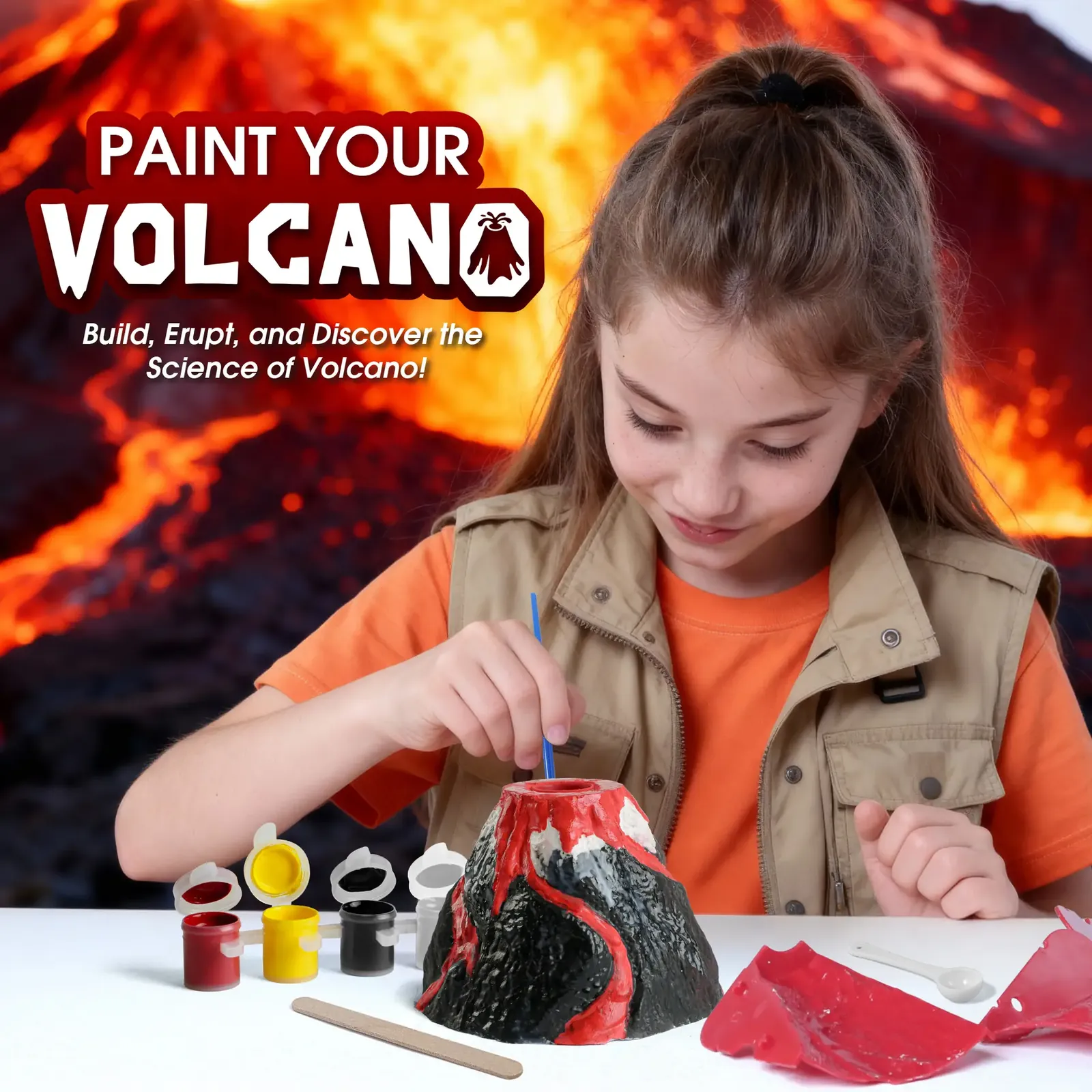
What You’re Actually Buying
| Type | What’s in the box | First eruption | Cost per run | Reuse | Price |
|---|---|---|---|---|---|
| Plastic model | Shell, inner bottle, scoop, dye, baking soda | Under 5 minutes | ¥10–25 | Bottle 20–50 runs; shell 50–100 | ¥50–150 |
| Plaster build | Plaster, mold, paint, brush, supplies | 30 minutes plus 24–48 hours | ¥10–25 | Mountain once; tools long-term | ¥80–200 |
| Refill pack | Soda, citric acid, dye, dropper, cups | Under a minute | ¥10–25 | Tools only | ¥30–80 |
| Pure DIY | Drinks bottle, clay, soda, vinegar | 10–20 minutes | ¥2.5–4 | Depends on the build | Under ¥10 |

Plastic Models
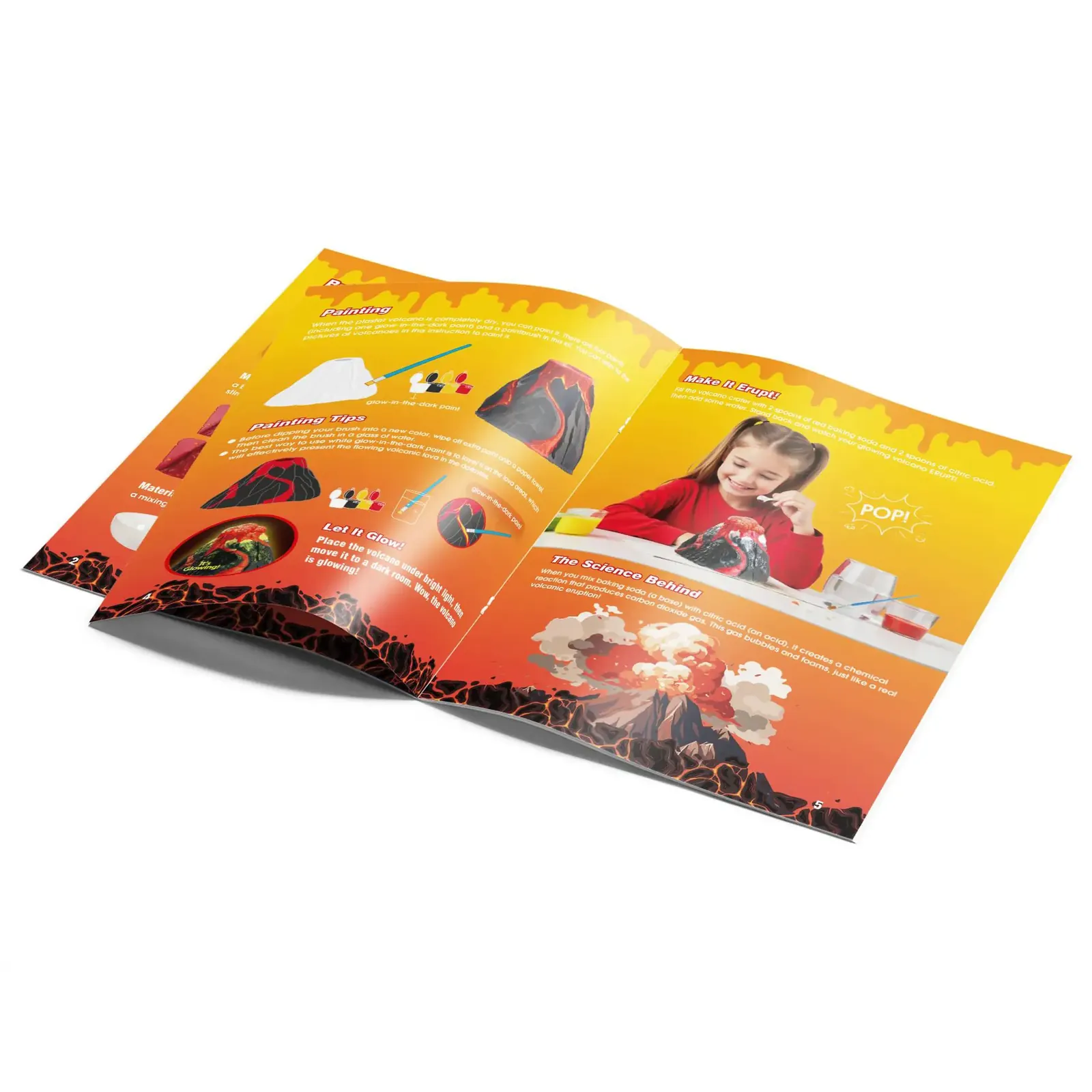
Check the inner bottle first. Somewhere between 300 and 500 ml works best. A 100 ml chamber produces 10–15 seconds of foam, a 250 ml chamber 10–25 seconds, a 500 ml bottle 25–45 seconds, and a 1 L setup 45–75 seconds.
The nozzle matters more than most parents expect. Keep it between 1.5 and 3 cm. Going from 3 cm down to 1.5 cm roughly doubles the height and halves the spread. The tray should be at least 3 cm deep, otherwise the foam reaches the table.
A 500 ml bottle usually pauses for 2–5 seconds before anything happens. Kids often read that pause as failure. It just needs a moment.
There is one design detail worth checking before you pay. If the inner bottle cannot be removed, skip that model. Liquid trapped in the seams sours within 24 hours, and the second run smells like a gym bag.
Plaster and Clay
Plaster costs very little. The catch is the drying time, which is the part nobody warns you about. A kilo runs ¥10–20 and paint another ¥15–30, so materials land at ¥25–50. Setting takes 20–40 minutes, and full drying takes 24–48 hours, longer wherever the shell is more than 2 cm thick.
Mix roughly 2:1 powder to water. Brands vary, so read the bag. Keep the shell 1.5–2 cm thick. Bury a 500 ml bottle in the plaster before it sets. Carving the cavity afterward cracks the mountain more often than not. The plaster warms up as it cures, so don’t let a child hold the wet mix for long.

You only get one eruption out of the mountain itself. If you want to use it again, wrap just the bottom half of the bottle and swap bottles later. Oil-based clay is another option: 200–500 g covers a 500 ml bottle, and it can be reshaped after a wipe. Cardboard and foil cost under ¥5, but they sag after two runs. If gathering plaster, paint, and a mold separately sounds like a chore, Piano Potato’s glow volcano kit packs the mold, plaster, paint, and a glow finish into one box, rated for ages 8 and up.
The Reaction and Ratios
NaHCO3 + CH3COOH → CH3COONa + H2O + CO2. 15 g of baking soda is 0.18 mol, which makes about 4.3 L of gas at 25°C.[1]
That is eight 500 ml bottles of gas, forced through a 1.5–3 cm hole.
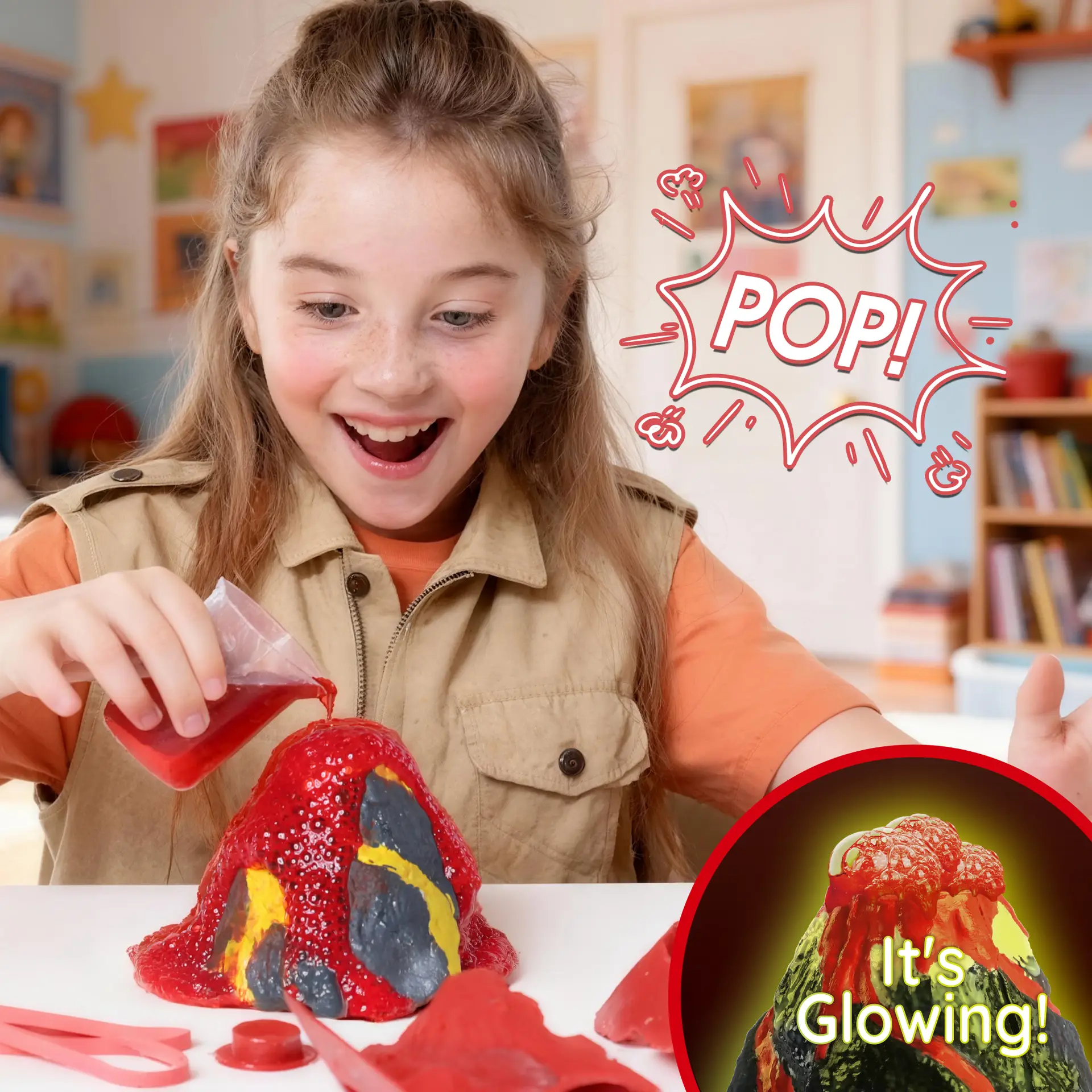
Use 1 g of soda for every 14 ml of 5% white vinegar. Most recipes online skimp on the vinegar. Put 50 ml in a 500 ml bottle and the eruption quits after 8–10 seconds. Once you pass 210 ml, extra vinegar adds smell and nothing else.
| Bottle | Baking soda | Vinegar | Dish soap | Dye | Run time |
|---|---|---|---|---|---|
| 350 ml | 2 tsp, 10 g | 100–140 ml | 3 drops | 2 drops | 15–30 sec |
| 500 ml | 1 tbsp, 15 g | 150–200 ml | 3–5 drops | 2–3 drops | 25–45 sec |
| 1 L | 2 tbsp, 30 g | 300–400 ml | 5–8 drops | 3–5 drops | 45–75 sec |
Keep the liquid at or below 2/5 of the bottle. The amounts above supply 70–98% of the theoretical vinegar, which leaves 2–30% of the soda in the bottom. The eruption ends a little sooner, and the cleanup is the same.
The order you add things in makes a difference. Put the soap and dye in the empty bottle, add 50 ml of warm water below 40°C, then the soda, then all the vinegar at once. Pouring in stages gives you a stop-start fizz that finishes sooner.
Supplies
- Baking soda, 10–30 g. One tablespoon is about 15 g. Washing soda works too, but you’ll need more of it.
- 5% white vinegar, 100–400 ml, or roughly 14 times the weight of the soda. Citric acid replaces it at 11–12 g for 15 g of soda and costs about ¥0.25–0.5 a run — less than vinegar, with no smell.
- Dish soap, 3–5 drops. Adding more won’t make the eruption taller. Dye, 2–3 drops; beyond 10 drops it starts staining.
- Measuring spoons, goggles for pH 2.4 vinegar, and a tray at least 3 cm deep.
What Changes the Result
Warm water speeds the reaction. Moving from 20°C to 40°C cuts the delay from 2–5 seconds to 1–2 and shortens the whole run by about 30%. Vinegar at 9% does the same job in half the volume. Ten drops of soap instead of three gives a thicker head that collapses within 30 seconds.
The reaction absorbs heat, roughly 30 kJ/mol, so the liquid drops 3–4°C. An IR thermometer pointed at the bottle will show a 2–5°C gap against the room. The same reaction runs bath fizzers and other fizzing kits, which is a cheaper way to repeat the chemistry once the volcano is done.
Reuse and Real Cost
The shell holds up for 50–100 runs. The inner bottle usually lasts 20–50. Trays, scoops, and goggles last for years unless someone loses them. Soda, vinegar, and plaster are single-use.
The bottle neck fails first. After 20–50 rounds of pushing a bottle in and out, it stops sealing. A standard 500 ml drinks bottle costs ¥1–2, so a replacement runs 1/25 to 1/150 of a new kit.
| Item | Price | Runs | Per run |
|---|---|---|---|
| Baking soda, 500 g | ¥8–15 | 33 | ¥0.25–0.45 |
| White vinegar, 500 ml | ¥5–8 | 2.5 | ¥2.0–3.2 |
| Refill pack | ¥30–80 | 3–5 | ¥10–25 (typical) |
| DIY total | — | — | ¥2.5–4 |
Over 50 sessions, the model works out to ¥1–3 a run. Supplies cost ¥2.5–4 and make up 57–71% of the total. That total assumes vinegar; citric acid drops the acid cost under ¥0.5 and the run under ¥1.2. Twelve weekly sessions cost ¥30–50 with your own supplies, or ¥120–300 with refills.
Ten sessions look like this. DIY comes to ¥35–50. A model with your own supplies lands at ¥75–190, a model with refills at ¥150–400, and a plaster kit at ¥180–450.
Ages and Stages
| Age | Solo | Needs an adult | Look for |
|---|---|---|---|
| 3–5 | Dye drops, watching | Everything | Big parts, no tiny dye bottles |
| 6–8 | Measuring a scoop, pouring, wiping | Vinegar, goggles, spills | Marked tools, picture instructions |
| 9–12 | Ratios, timing, simple comparisons | Vinegar and spills | Log sheet, variable cards |
| 12+ | Multi-variable runs, write-ups, boards | Strong acids or heated kits | Better manual, more experiments |
An “8+” label covers small parts and manual skill, not chemistry. Follow it for unsupervised use; younger kids can mix with an adult.
Kids under three shouldn’t take part. The small-parts test cylinder is 31.7 mm wide and 57.1 mm deep, and anything that fits inside counts as a choking risk, including clumped soda and bottle caps.[2]
Before age twelve, keep the vinegar in adult hands. It sits at pH 2.4. If it reaches an eye, flush with water for 15 minutes and start within the first 15.
Safety
- Never seal the bottle. With 15 g of soda and 200 ml of vinegar in a 500 ml bottle, pressure can pass 10 atmospheres. A drinks bottle is built for less than 10.
- Keep bleach out of the room. 84 disinfectant and acid release chlorine gas, and low levels are enough to sting a small bathroom.[3]
- Skip industrial acid. Industrial acetic acid and descalers reach 30% or more, and at that strength they burn skin.
- Don’t let anyone taste it. Food-grade ingredients stop being food once soap and dye go in.
- Put down newsprint or a waterproof mat. Vinegar etches marble, limestone, and terrazzo, and the dull spot stays.
- Wear old clothes. Food dye binds to cotton and resists washing.
- Open a window. Vinegar is hard on kids with asthma, so citric acid is a reasonable swap.
- Blot the foam with paper towels before wiping. A sink full of foam clogs easily.
Kits with bulbs, heaters, or smoke effects need an adult at the plug. Foam that reaches the battery bay can short it, so pull the batteries before cleanup.
Storage and Cleanup
- Rinse the bottle and tray within 24 hours. Dried foam turns sticky and keeps the smell.
- Keep soda in a sealed jar. Clumps change the dose and delay the start.
- Store vinegar away from bleach and descaler, and label the bottle if you decant it.
- Dilute leftover liquid before it goes down the drain. Plaster goes in the bin, never the sink.
When It Won’t Erupt
| Symptom | Likely cause | Fix | Target |
|---|---|---|---|
| Barely reacts | Damp soda; vinegar at 3.5% acid | New soda; check the label | 2–5 sec to start |
| Fizzes, won’t spray | Under 3 drops of soap; nozzle over 3 cm; liquid over 2/3 | Add 3–5 drops; narrower neck | 2/5 or less |
| Stops after a second | Not enough vinegar | Top up to 150–200 ml | 150–200 ml for 500 ml |
| Leaks at the base | Seam not sealed; tray under 3 cm | Clay the seam; deeper tray | Tray 3 cm or more |
| Sprays everywhere | Water over 40°C; vinegar essence over 15%; nozzle under 1.5 cm | Cool water; dilute; wider nozzle | 20–25°C |
| Grey, smelly foam | Old liquid, 24 hours or more | Rinse and dry after every run | — |
Turn It Into an Experiment
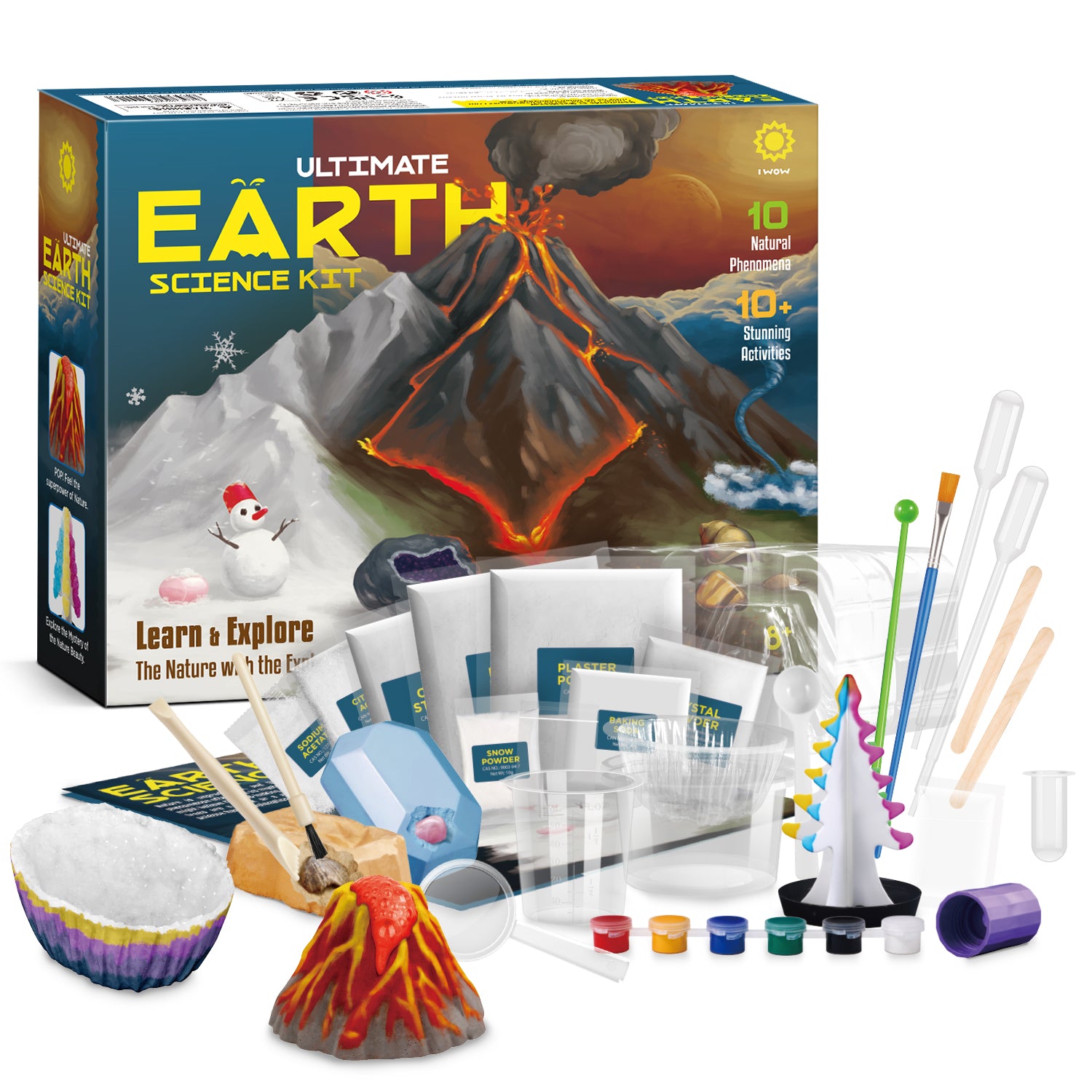
Four variables and twelve conditions. One pass through all of them costs about ¥50 and takes two hours. Find the point where the curve flattens, then repeat those conditions three times. For a wider unit, the Ultimate Earth Science Kit covers ten phenomena instead of one.
| Variable | Hold constant | Change | Record |
|---|---|---|---|
| Vinegar volume | 15 g soda, 500 ml bottle | 50, 100, 150, 200 ml | Duration, peak height |
| Water temperature | 15 g soda, 200 ml vinegar | 20, 30, 40°C | Delay, total time |
| Nozzle size | Same bottle, same dose | 1.5 cm vs 3 cm | Height, spread |
| Soap | Same bottle, same dose | 0, 3, 10 drops | Foam life |
Use six columns: run number, what changed, what stayed the same, duration, peak foam, and notes. Without the last three, you end up with twelve numbers that cannot be compared.
“Vinegar went from 50 ml to 150 ml and the run went from 8 seconds to 32. At 200 ml it was 34 seconds, so the extra vinegar stopped mattering.”
- About 1,350 potentially active volcanoes exist, many of them around the Pacific. Magma runs 700–1,200°C.[4]
- Pinatubo’s 1991 column reached 35 km, roughly 100,000 times the 30 cm of foam on your counter.[5]
- Silica drives viscosity. Igneous rock runs from about 45% to 78% silica; Pinatubo’s dacite sits around 64%, Kilauea’s basalt around 50%, and the gap covers several orders of magnitude. One lava flows, the other traps gas until it explodes. Cornstarch in the “lava” shows the difference.[6]
- A 2 L balloon fills with gas to spare, so the foam really is escaping gas and not soap bubbles alone.
When the interest moves from eruptions to rocks, a rock-and-mineral kit is the next step.
Buying Checklist
Work out cost per session by dividing the model price by the number of runs, then adding supplies. A ¥50 model used twice costs ¥25 a session. A ¥150 model used twenty times costs ¥7.5.
- If the box lists no ingredients and no dose per run, walk away.
- A proprietary refill connector means you’re stuck buying their packs.
- Look for GB 6675 compliance and the CCC mark. Without them, don’t buy.
- Manuals that are English-only or machine-translated often drop the safety warnings.
- If the box claims 100 uses but ships three runs of powder, budget ¥10–25 per run.
A kit with a ratio card, a variable sheet, a log sheet, and measuring spoons can be repeated. A model plus two packets of powder can be repeated too, but only by buying ¥30–80 refills.
How This Guide Was Built
- Gas volumes, pressure, and ratios are calculated from molar masses and the ideal gas law at 25°C and 1 atm. They are not copied from kit manuals.
- Prices are October 2026 retail ranges for 500 g soda, 500 ml 5% vinegar, and 3–5-run refills. Treat them as ranges, not quotes.
- Safety limits come from 16 CFR 1501.4 for small parts, PubChem hazard records for chlorine, and USGS and NPS data for the volcano comparisons.
- No third party paid for placement. Piano Potato sells the glow kit linked above; the numbers, not the margin, set the recommendations.
FAQ
Can I use baking powder?
It carries its own acid, so it starts fizzing the moment water touches it. You get a faster, thinner foam and a shorter eruption.
What if a kid swallows some?
A small taste usually means a sore mouth and some burping. Rinse and don’t force vomiting. If a child keeps vomiting, has trouble breathing, or swallows dye or cleaner, call a doctor and bring the package.
Can we do this in the bathtub?
It works, but use a non-slip mat and rinse right away. Dye can stain glaze after about ten minutes. Leave glass out of the tub.
Can it go to school?
For ten kids, bring 2 L of vinegar, ten trays, and two rolls of paper towels. Run three or four at a time, or use party and group play kits sized for that headcount.
How is this different from elephant toothpaste?
That demo uses hydrogen peroxide with yeast or iodide. The foam is hotter and denser, and the setup needs more gear. A volcano kit has no oxidizer, so it is much milder.
Wholesale and private label
Need volcano kits by the carton instead of the box?
Piano Potato makes volcano kits and more than 300 other toys and STEM sets, and handles private label from design to packaging. Send the age band, runs per box, and your packing deadline to start a quote.
Where the numbers come from: gas volume, pressure, and ratios come from stoichiometry and the ideal gas law at 25°C and 1 atm. Prices, reuse counts, timings, and temperature effects are October 2026 retail ranges and rules of thumb, not lab measurements. No brand testing and no affiliate links. Check the listing before you buy.