
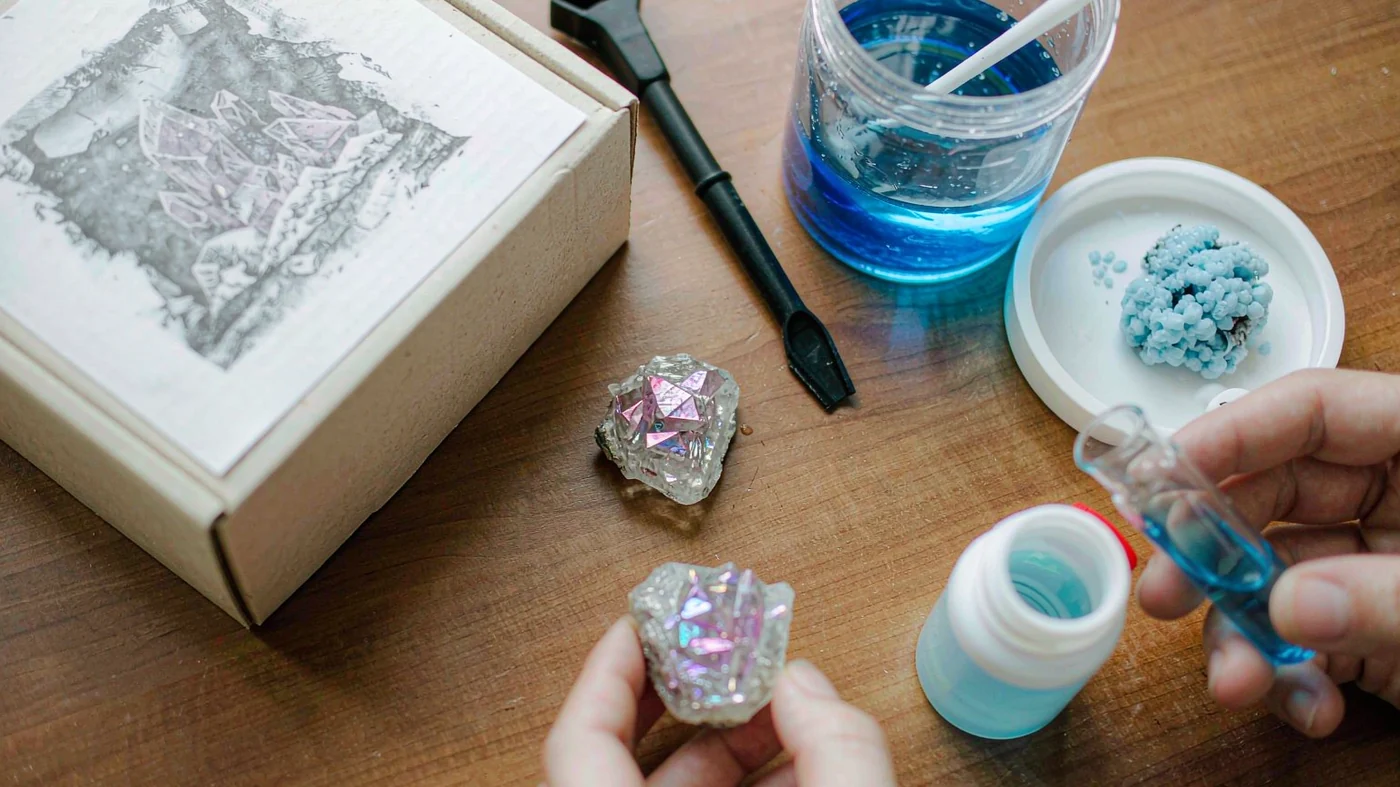
Crystal mining kits uncover stones that already exist; crystal growing kits form new crystals from a solution. Mining centers on chipping and brushing a dig block, then sorting the finds. Growing centers on measuring, mixing, and observing change. Some crystal-growing methods show results within hours, while larger seed-crystal projects can take days or weeks [1].
Choose mining when the goal is a digging activity with stones to take home at the end. Choose growing when the goal is to watch crystals develop over time. Check the individual kit’s age label and instructions before deciding: neither the word mining nor growing tells you its exact duration, contents, or supervision requirements.
Key Differences
| What Changes | Crystal Mining Kit | Crystal Growing Kit |
|---|---|---|
| Starting material | A dig block containing pre-packed stones or specimens | Crystal-growing material, usually supplied as powder, with a seed crystal or growing base in some kits |
| Main activity | Excavating, brushing, and sorting | Measuring, dissolving, and observing crystal growth |
| Waiting | No crystal-growth stage; digging time and any soaking depend on the instructions | Hours to weeks in the university methods discussed below, depending on material and desired crystal size [1] |
| Result | The specimens originally hidden in the block | Crystals formed during the activity |
| Practice | Careful tool use, observation, and classification | Following measurements and recording changes over time |
| Workspace | A tray or protected work surface for chips and dust | A protected mixing area and a suitable place to leave the growing container |
| Main precautions | Digging tools, flying chips, dust, and small finds | Powder handling, spills, small components, and hot water if the instructions require it |
| After the activity | The excavated block is used up; the stones can be stored and sorted | Further batches depend on remaining material or a compatible refill, not merely on having a reusable cup |
What Mining Kits Contain
A crystal mining kit, also called a gemstone dig kit, hides specimens inside a block that the child works through with small tools and a brush. Depending on the product, those finds may be rough mineral pieces, polished stones, or imitation items. The activity reveals what was packed inside; it does not create the stones.
When comparing sets in the Dig & Explore collection, look for a named contents list rather than relying on a photograph of colorful pieces. Count and variety are different promises. A kit with several pieces of the same material can have a high specimen count without offering many mineral types. The distinction also matters when checking gem dig kit contents for natural stones, treated pieces, or imitations.
How Growing Kits Work
A growing kit usually supplies crystal-growing material and instructions, with a container, seed crystal, or base depending on the set. A seed crystal is a starting point for growth, not the finished display. The project is to form new crystals, rather than uncover specimens hidden in a block.
In the solution-based methods described by Penn State, material dissolves in water. Cooling or evaporation can make the solution supersaturated: it contains more dissolved material than can remain dissolved under those conditions. The excess material then forms crystals. Dissolving is not melting, and the water temperature and mixing amounts should come from the kit’s own instructions [1].
Within the Crystals & Supplies collection, compare the stated growing material, required preparation, and expected observation period. Different materials do not necessarily share a recipe. The guide to crystal types and growing times provides additional product-selection context.
Time and Results
A mining activity can be planned around a digging session, but there is no universal completion time. Block size, hardness, tools, and the child’s pace affect how long excavation takes. Some instructions allow wetting or soaking; others may not. Do not assume that every block or every stone can be soaked.
Growing separates preparation time from result time. Penn State’s Epsom salt example starts with one cup of warm, not boiling, distilled water. Epsom salt is added by the spoonful until no more dissolves, approximately one cup in that method. The clear solution is poured into a shallow bowl, leaving undissolved salt behind, and refrigerated for three hours to look for early crystals [1].
The same university activity uses one-quarter to one-half cup of hot distilled water for its alum method and leaves the solution in a shallow dish outside the refrigerator for a couple of days. It notes that small crystals may start within about an hour as the solution cools. Its separate seed-crystal extension can take days or weeks. These are examples from that educational activity, not timing guarantees or substitute recipes for a packaged kit [1].
The practical difference is the deadline. A digging activity aims to reveal its contents during excavation. A growing activity needs an observation window, and early crystals may be much smaller than the display a child expects.
What Children Can Learn
Mining offers a collection to examine. Sort finds by visible features such as color, shape, transparency, and surface texture, then check the identification guide. Color alone does not establish mineral identity: amethyst and rose quartz are varieties of quartz [2]. In a hypothetical collection, five amethyst pieces, five rose quartz pieces, and five clear quartz pieces would give 15 specimens of one mineral species, not 15 different minerals.
That is why a gemstone dig kit’s specimen list matters more than a colorful assortment alone. The same sorting exercise can extend to other specimens in the Earth & Space collection, using the guide supplied for each set.
Growing offers a change to document. Record the material, start time, first visible crystals, and changes in shape or size. Photos taken from the same position make comparisons easier. If a further experiment is permitted by the instructions, change one variable rather than several at once. A crystal-growing chemistry lesson can then compare the child’s prediction with the recorded result.
Real Crystals and Natural Stones
Grown crystals are not automatically fake: crystal structure and natural origin are different questions. Penn State describes crystals by their ordered atomic arrangement, while the National Park Service includes natural occurrence among the defining characteristics of a mineral [1][3]. A crystal formed in a home experiment is therefore not the same claim as a naturally occurring mineral specimen.
For a mining kit, check whether the seller identifies the stones as natural, treated, laboratory-grown, or imitation. For a growing kit, check the named growing material; do not assume the result will be quartz merely because the packaging shows a sparkling cluster. Neither activity alone establishes rarity, jewelry quality, or untreated natural origin.
Age Labels and Safety
Neither kit type is automatically suitable for younger children. Mining requires attention to tools, chips, and dust. Growing adds handling of chemical material and, in some methods, hot water. Read the warnings before opening either set. Where hot water is required, plan for adult handling. Directive 2009/48/EC’s definition of a chemical toy describes age-appropriate direct handling of chemical substances or mixtures under adult supervision [4].
Small components can occur in both types, including stones, seed crystals, or tools. In the United States, children’s products intended for children under three that present a choking, aspiration, or ingestion hazard because of small parts are banned under the small-parts rule. Applicable products also require choking-hazard labeling. A warning is not a reason to disregard the kit’s stated age range [5].
For U.S. toy compliance, the CPSC’s guidance identifies ASTM F963-23 for toys manufactured after April 20, 2024. Applicable requirements depend on the product; mentioning a standard does not prove that a particular kit complies [6]. Ask about the specific kit, its age grading, and its warnings rather than treating a general product safety policy as an individual test report.
Keep powders sealed until use and avoid ingestion or inhalation. Keep materials and used equipment separate from food and drink, and follow the kit’s instructions for protective equipment, cleaning, and disposal. Keep both kinds of kit and their small parts away from younger siblings. These precautions do not replace the instructions for the product you have.
Workspace and Cleanup
For mining, prepare a tray or protected surface and a place for the finds before excavation starts. Contain dust and chips, and stop to review the instructions if pieces are flying. Brush or rinse specimens only as permitted for the materials in the kit.
For growing, prepare the mixing area and a suitable location for the container before starting. Follow any instructions about leaving it undisturbed, adding water, removing crystals, or handling leftover solution. Do not assume that a dry crystal is safe to handle or that leftover liquid can go down the drain; use the product-specific directions.
Planning a Group Session
Consider a planning example with 24 children, each using one individual set. If each mining set has one block and one tool set, the calculation is 24 blocks and 24 tool sets. Provide a protected working position for each child and somewhere to keep their finds. This is a quantity calculation, not a record of a classroom trial.
For the growing alternative, assume one container per child: 24 children require 24 containers and enough suitable space to leave them for the instructed growing period. A one-week observation plan is a scheduling choice, not a promise that every kit will finish in seven days. Before choosing, identify who will handle any hot-water preparation and who will supervise later checks.
A useful observation record has a start date, the named material, a photo, and the time the first crystals become visible. If the growing period extends beyond the last class, arrange who will continue the observations. This is the practical commitment that a digging-only session does not have.
Choosing Between Them
- Choose mining for excavation and a collection of finds, including a supervised group or party activity when the instructions and age labels fit the children.
- Choose growing for measuring and observing crystals develop, when you can provide the required preparation, supervision, and growing space.
For classroom or store orders, compare the named contents, equipment supplied, age label, and instructions before checking wholesale ordering terms. A count of stones is not directly comparable to a count of powder packets: they support different activities.
Choosing kits for a class or store?
Share the children’s age range, group size, and available time. Ask about kit contents, instructions, and product-specific safety information before ordering.
References
- Penn State MRSEC, Growing Crystals. Crystal structure, cooling and evaporation methods, Epsom salt and alum examples, and the seed-crystal extension.
- U.S. Geological Survey, Quartz, Scientific Investigations Report 2017-5118. Amethyst and rose quartz as varieties of quartz.
- U.S. National Park Service, Minerals. Defining characteristics of naturally occurring minerals.
- European Union, Directive 2009/48/EC on the safety of toys, Article 3(21). Definition of a chemical toy and adult supervision.
- U.S. Consumer Product Safety Commission, Small Parts Ban and Choking Hazard Labeling. Small-parts hazards, the under-three rule, and applicable warning labels.
- U.S. Consumer Product Safety Commission, Toy Safety Business Guidance. ASTM F963 and the manufacture-date applicability of F963-23.