
Difficulty tracks the reagent list more than the age sticker. A chemistry set puts citric acid at 20 g, copper sulfate and potassium permanganate at 15 g each. A crystal growing set lifts copper sulfate to 50 g and alum to 600 g.[1]
The age number is a floor rather than a target. EN 71-4:2013 sets it at 8, potassium permanganate forces 12 whatever else sits in the box, and a crystal growing set caps any single container at 200 g.[1]
Session length separates the bands. A first set finishes in 10 to 15 minutes, and a crystal takes 3 to 7 days before there’s anything to look at.
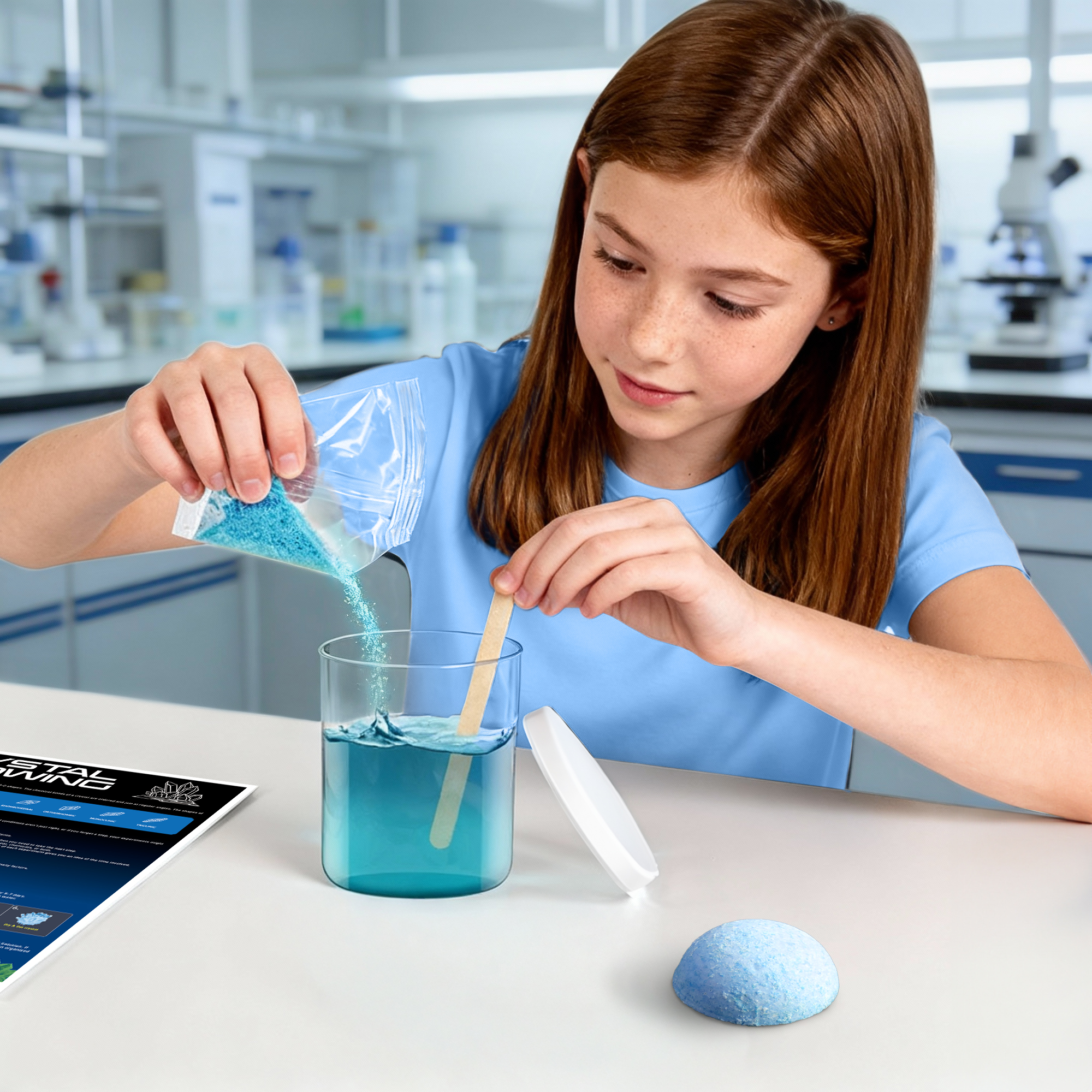
Three markers say a set is a step too hard. Weighing to 0.1 g, heating a test tube, and a single wait longer than 10 minutes.
Where the age lines come from
The floor is 8
EN 71-4:2013 leaves the age number to the maker, the authorised representative or the importer and fixes one floor. Not below 8. The same warning marking is repeated on the outer page of the instruction front cover, so it appears twice rather than once.[1]
The wording is a fixed template of 8 sentences and 72 words, with 2 blank age slots sitting in sentences 2 and 8. Clause 6.3.2 sets the text.[1]
Warning. Not suitable for children under (*) years. For use under adult supervision. Contains some chemicals which present a hazard to health. Read the instructions before use, follow them and keep them for reference. Do not allow chemicals to come into contact with any part of the body, particularly the mouth and eyes. Keep small children and animals away from experiments. Keep the experimental set out of reach of children under (*) years old.
Potassium permanganate pushes it to 12
Potassium permanganate is capped at 15 g and marked with 3 pictograms, GHS03 for oxidising, GHS07 for harmful and GHS09 for the environment. The footnote under Table 1 moves it to the 12-plus shelf.[1]
The same table allows 25 g of glycerol, and the two self-ignite on contact, with about 0.1 mL enough to start it. Iron powder is capped at 100 g and hexamethylenetetramine solid fuel at 10 g, both wearing the GHS02 flame.[1]
Three markets, three rulebooks
| Market | Basis | Age rule | Key limits |
|---|---|---|---|
| EU | EN 71-4:2013, harmonised standard under Toy Safety Directive 2009/48/EC[2] | Not below 8; not below 12 with potassium permanganate | Copper sulfate 15 g (chemistry set), 50 g (crystal set); no more than 200 g per container in a crystal set |
| US | 16 CFR 1500.85(a)(1) and 1500.83(a)(23)[3] | No age number. The label must say adult supervision is required | Chemistry sets are exempt from the “banned hazardous substance” category; the price is per-container labelling |
| China | GB 26387-2011, modified adoption of BS EN 71-4:2007[4] | Same age floor | Same substance tables, plus GB 6675.13 for non-experimental chemical sets |
The number means different things in each market. The EU fixes a floor at 8, the US prints no age at all and leans on the supervision line instead. That makes the age bands printed on the box a filter, and the reagent caps the verdict.
Meet EN 71-4:2013 and you are presumed to meet the Toy Safety Directive.[5] The US runs the other way. Under 16 CFR 1500.85(a)(1) a chemistry set is exempt from the banned-hazardous-substance category only where the labelling under 1500.83(a)(23) is done properly.[6] Below both sit ASTM F963 for the US toy specification and the Office for Product Safety and Standards for UK market surveillance.[7][8]
The US caution statement runs 3 sentences and 27 words, with the signal word WARNING hung off the front on a dash. It goes on the manual’s front page or cover and the carton’s main display panel, at a type size set by 1500.121.[6]
WARNING—This set contains chemicals that may be harmful if misused. Read cautions on individual containers carefully. Not to be used by children except under adult supervision.[6]
How the two standards are built
China’s GB 26387-2011 came out on 12 May 2011, took effect on 15 September, and had its first review on 31 December 2016. GB/T 6675.9-2025 takes over from it.[4][9]
EN 71-4:2013 is built from 8 clauses and 5 annexes. Limits sit in clauses 4 and 5, marking in clause 6, the contents list in clause 7 and the safety rules in clause 8. Its Annex D records what moved from the 2009 edition. The scope was widened to crystal growing and CO2 generating sets, clove oil came out of Table 1, and the old hazard symbols gave way to GHS pictograms with INDEX numbers added.[1]
Breaches get published. The EU keeps a live alert list of dangerous non-food products pulled from shelves, and China’s market regulator issues recalls the same way.[10][11]
What sets the difficulty
What’s allowed in the box
Reagents come from Table 1 and Table 2 and nowhere else. Table 3 lists 4 you supply yourself, Table 4 spreads crystal growing across 5 amount tiers, Table 5 lists 8 substances for CO2 generating, and Table 6 fixes volumes for 4 empty bottles.[1]
The concrete caps run ammonium chloride 30 g, citric acid 20 g, sodium carbonate and sodium bicarbonate 50 g each, copper sheet 100 g. The corrosive rows are calcium hydroxide 20 g, calcium oxide 10 g, iron(III) chloride 10 g and sodium hydrogen sulphate 30 g, all wearing GHS05.[1]
Ninhydrin sits at the bottom with 1 g and lactose and lead-free solder top out at 100 g, a hundredfold spread. Table 2’s indicators are just as tight, with eosin, litmus blue and litmus red all on 1 g. An entry level science experiment kit usually packs 6 to 12 reagents, which at the median cap of 15 g is 90 to 180 g of powder.[1]
The pictograms and the H and P phrases come from the CLP Regulation rather than the toy standard, and clause 7 of EN 71-4 points there instead of repeating them.[12][1]
Four reagents never ship in the box. Hydrochloric acid, sodium hydroxide solution, ammonia solution and hydrogen peroxide all stay out, and the manual can only suggest you supply them, capped at 2 mol/L for the acid and the ammonia and 1 mol/L for the hydroxide and the peroxide. Run any of them in a classroom rather than a kitchen and the same four fall under a COSHH assessment.[13]
Percentage labels are allowed alongside mol/L. The four caps work out at 7.3 g of hydrogen chloride per 100 mL, 3.4 g of ammonia, 4 g of sodium hydroxide, and a 3% solution for the peroxide. The pH at the two ends reads −0.3 and 14.[1]
Peroxide is the one Table 3 spells out in shop terms, noting that its 1 mol/L cap is equivalent to a 3% (volume fraction) solution. At that strength a 100 mL bottle holds enough for about 1 L of oxygen, and a 10 mL run about 100 mL.[1]
Empty bottles are capped as well, 50 mL for ammonia and 100 mL for each of the other three. At the concentration caps that puts 1.7 g of ammonia in the smallest and 7.3 g of hydrogen chloride in the acid bottle.[1]
Only one ethanol item appears in Table 1, and it is tincture of iodine, capped at 10 mL with iodine at 0.025 g/mL. The whole bottle works out at 0.25 g of iodine and wears GHS02 plus the strongest signal word.[1]
When an adult has to stand there
Goggles ship with every chemistry set, and a crystal growing set only needs them where a GHS05 substance is inside. That is the difference between a geodes kit that ships goggles and one that leaves them out. Where the box omits the pair for the adult, the primary packaging has to print “Eye protection for supervising adults is not included”.[1]
Heat a test tube and the set has to include a working holder. The rack has its own test, 5 mL of water in the outermost hole with the rack tilted 15°. Glassware is judged borosilicate or not by density, on a 25 mL pycnometer and a 20 °C bath; borosilicate reads about 2.23 g/mL against 2.5 g/mL for soda-lime.[1]
Step count and failure cost
Baking soda and vinegar answers in 5 minutes and a failed run costs one spoonful. A slime science kit sits in the same band with no heat and no gas. Crystals take 3 to 7 days, and one poke resets the clock. An 8-year-old’s experiment usually runs 3 to 6 steps with no single wait over 10 minutes.
Your kitchen scale reads to 1 g and solutions often want 0.1 g. A 10 mL cylinder marked every 0.2 mL puts 5 mL out by 4%, and a 5 mL cylinder marked every 0.1 mL brings that to 2%. At 12 the set adds heating and settling, and an afternoon buys 2 or 3 experiments against 4 to 6 for the same hours at 8.
| Tier | What it looks like | Age floor | Typical substances and amounts | One session |
|---|---|---|---|---|
| Visible change | Pour, stir, watch — no gas | 4 | Honey, corn syrup, water, cooking oil, poured densest first | 10 to 15 minutes |
| Kitchen shelf | Measure, mix, wait | 6 | Baking soda, white vinegar, red cabbage juice | 15 to 30 minutes |
| Real reagents | Weigh, test tube, test paper | 8[1] | Citric acid 20 g, sodium bicarbonate 50 g, copper sulfate 15 g | 20 to 40 minutes |
| Heat and crystals | Heat, leave it, work the ratios | 8 (crystal set), 12 (with potassium permanganate)[1] | Copper sulfate 50 g, alum 600 g, potassium permanganate 15 g | 30 minutes plus; crystals add 3 to 7 days |
Picking experiments by age
Preschool experiments
No GHS pictogram shows up at this stage, so the reagent list says nothing and the certification behind the box is what you screen instead. Density layers, colour mixing and the baking soda trick fill the band, 3 families at 10 to 15 minutes each.
A 250 mL glass is enough for the density tower, honey at 1.42 g/mL, corn syrup 1.33, water 1.00 and cooking oil 0.92. Pour 50 mL of each and the honey layer weighs about 71 g against 46 g for the oil, 234 g for all four.
1 g of sodium bicarbonate releases about 0.29 L of CO2, more than the 250 mL glass can take, so the fizzing one wants 1 L or more. CO2 is 1.8 g/L against 1.2 g/L for air.
The kitchen shelf stage
500 g of baking soda and 500 mL of white vinegar together cost under 20 yuan. Labels list total acid at 3.5 to 5 g/100 mL, which at the 5% mark is 5 g of acetic acid per 100 mL, or 0.083 mol.
That 0.083 mol neutralises about 7 g of baking soda, and the same arithmetic run backwards makes 500 mL of vinegar good for 5 rounds of the 100 mL to 7 g recipe, while the 500 g box of baking soda would stretch 14 times further. At 20 yuan for both, a round lands near 4 yuan, which is the figure a kit on cost per experiment has to beat.
The same reaction drives a volcano kit, where 7 g against 100 mL is the whole eruption. Kitchen spoons manage it, a teaspoon of baking soda running 4.6 g and a teaspoon of vinegar 5 g.
Red cabbage juice covers 10 pH units from 2 to 12 and the eye separates 5 or 6 shades. Phenolphthalein covers only 8.2 to 10 and litmus 4.5 to 8.3. Test paper reads to 1 unit and narrow-range paper to 0.2 or 0.5.
Chlorine bleach stays out of reach at this stage, at 5% to 10% on the label.[14] For the rest of the shelf, the EPA’s Safer Choice list screens on ingredient criteria rather than brand.[15]
First real reagents
Every substance sits in a child-resistant container, either meeting EN ISO 8317 or needing two separate moves, and it holds against 70 N pulling up, 30 N pushing down and 0.5 N·m of torque.[1]
Liquid containers get dropped 5 times from 850 mm onto 4 mm steel, filled to three-quarters with the cap facing down. Ask for that record in writing, and suppliers who publish how their kits are tested and certified put the closure standard and the drop height on the page.[1]
Most sets ship 1 pair of kid goggles and leave the adult pair to you. Experiments here take 20 to 40 minutes, and a 60 to 300 yuan starter set spread over 20 runs lands at 3 to 15 yuan a go.
Heat and crystals
Crystal sets loosen the reins. Copper sulfate, citric acid, tartaric acid and iron(II) sulfate each get 50 g, magnesium sulfate and sodium sulfate 100 g. A basic crystal growing kit ships a few grams and a container, so those figures are the ceiling the standard allows rather than the contents of the box.[1]
Table 4 stacks into 5 tiers at 5 g, 30 g, 50 g, 100 g and 600 g. Two substances sit in the 5 g tier, strontium aluminate and zinc sulfide, while 7 fit in the 600 g tier, among them alum, sodium thiosulfate and potassium dihydrogen phosphate. That 600 g is 60 times the 10 g of aluminium potassium sulfate in Table 1 and 120 times the 5 g of zinc sulfide in Table 4.[1]
Caps are set on the anhydrous form, so the pack you buy is heavier. 50 g of copper sulfate is about 78 g of blue vitriol, the 15 g tier is 23 g, and 600 g of alum is about 1.1 kg of the dodecahydrate.[1]
Outside the toy standard, ECHA classifies copper sulfate pentahydrate as acute toxicity category 4 and serious eye damage category 1, plus two aquatic hazards, and that eye call sits a notch above the category 2 irritation recorded for the anhydrous form. On an anhydrous basis 15 g of copper sulfate contains about 6 g of copper and 50 g about 20 g.[16][1]
ATSDR publishes a full toxicological profile for copper, which sets out dose rather than the concentration limits a toy standard works in.[17]
CO2 generating sets cap citric acid at 100 g, sodium bicarbonate at 100 g, malic and tartaric acid at 60 g each and potassium hydrogen carbonate at 50 g. Supplied as a solid mix, acid and gas-maker have to be chemically equivalent, which in moles is 192 g of citric acid against 252 g of baking soda, a mass ratio of 1 to 1.31.[1]
A crystal set can’t put two substances that react in the same box. Citric acid stays away from sodium bicarbonate and zinc sulfide from any acid at all. Crystal sets carry 13 safety rules against 11 for chemistry sets.[1]
The checklist before you pay
Four things belong on the contents list. The chemicals supplied, the H and P phrases for each, an empty space for the local poison centre or hospital number, and general first aid. The first aid block takes 6 lines, covering eyes, swallowing, inhalation, skin contact and burns, doubt, and injury.[1]
- Every reagent has a maximum amount beside it, and matching those numbers to the labels is the fastest audit.[1]
- Each reagent gets an identifier, INDEX number first. Copper sulfate 029-004-00-0, potassium permanganate 025-002-00-9, ammonium chloride 017-014-00-8, sodium carbonate 011-005-00-2. INDEX numbers run 9 digits in 4 blocks, EINECS 7 digits in 3.[1]
- Glassware not meant for heating is marked “Not to be heated” unless it is borosilicate.[1]
- The word Warning is set at 7 mm or larger and the warning phrases at 3 mm.[1]
Refills come in 25, 50 and 100 g. A 25 g pack at 2.5 to 5 g a go covers 5 to 10 runs for 1 to 6 yuan, and the 12-plus floor of 300 yuan is 5 times the 60 yuan floor at 8-plus.
Price says little about the closures or the glass, and the things that go wrong at month three rarely show up in a product photo, so run the four checks above before the number on the tag.
Where things go wrong
Two cleaners you never mix
Chlorine bleach meets an acidic toilet cleaner and releases chlorine gas. China CDC’s Institute of Environment puts it at number 1 on its household cleaning no-go list, and both bottles sit at 5% to 10% label strength.[14]
Chlorine is 2.9 g/L, 2.4 times air, so it pools below 1 m. An adult breathes at about 1.5 m, a child at 0.9 m. Breathe it in and you get streaming eyes and a cough, swallow it and you get nausea, vomiting, chest pain and diarrhoea.[14]
Bleach plus laundry detergent is number 2 on the same list and also throws off toxic compounds. At 5% to 10% bleach lands at 50,000 to 100,000 mg/L against the 500 mg/L home disinfection needs, 100 to 200 times stronger than the job. 10 mL of concentrate in 1 L of water gets there, and one 500 mL bottle makes 50 L.[14]
If it gets in an eye
For eye contact, rinse with plenty of water, hold the eyelid open if you have to, then get medical advice straight away. Skin contact and burns mean at least 10 minutes under the tap, and at 6 L a minute that is about 60 L of water.[1]
Swallowed it? Rinse the mouth, sip some water, do not induce vomiting, get medical advice. No symptoms at all still warrants a trip to the doctor, because mucosal damage can take hours to show. Two steps, then. Rinse, and take the container with you.[1]
Never swap bottles
Any experiment that touches food adds one line to the manual, that food doesn’t go back into its original container. Reagents never go into a drinks bottle either.[1]
US poison centres logged 2,092,689 human exposures in 2024, about 5,733 a day, plus 285,736 information calls.[18][19] The WHO keeps chemical safety as its own standing programme, independent of any one country’s poison-centre reporting.[20]
For children 5 and under the top 5 categories are household cleaners 9.96%, cosmetics and personal care 9.15%, painkillers 8.85%, foreign bodies and toys 7.92% and dietary supplements 6.34%, or 42.22% between them.[18]
The US Consumer Product Safety Commission counts 267,100 toy-related injuries in emergency rooms in 2024, about 732 a day. 68% hit children 14 and under, around 182,000 cases, and 34% the 4-and-under group, around 91,000. That year 45% landed on the head or face, 19% were lacerations, and 95% walked out after treatment.[21]
Toy-related deaths came to 6 in 2024 and 54 across 2022 to 2024. Injuries over the 8 years from 2017 to 2024 averaged 245,400 a year, which is 672 a day against the 5,733 a day of poison exposures, a gap of 8.5 times.[21][18]
Storing it
Of the 11 safety rules, the storage one says keep the set out of reach of children under the stated age. A shelf that isn’t the kitchen table meets that without a lock, and 4 of the 11 rules deal with cleaning and containers, 36% of the list.[1]
Locking a starter set away takes about 3 minutes, and clean-up runs 5 to 10, roughly 3 washing gear and 2 emptying containers.
Common questions
Can alum replace copper sulfate?
Yes. Alum’s 600 g cap is 12 times copper sulfate’s 50 g and both sit on the same 8-plus shelf. Alum has no GHS pictogram against GHS07 and GHS09 for copper sulfate, and the crystals differ, colourless octahedra against blue triclinic.[1]
When the experiment is over the line
The potassium permanganate line doesn’t move, 15 g the ceiling and age 12 the floor. Have your child recite the safety rules first, and 5 of the 11 is the bar for working under goggles.[1]
How long one session takes
Set-up 10 to 15 minutes, hands-on 15 to 40, clean-up 5 to 10, all inside an hour. A 20-week term at one session a week is 1,000 minutes, close to 17 hours, enough that a whole term of hands-on science gets planned in one sitting.
The American Chemical Society keeps a free lesson library sorted by grade band, K to 2, grades 4 to 6 and 6 to 8, with ready-made activities in each.[22]
Opening-day check
Ten minutes after opening the box, three things settle the first session. Check the reagent maximums against the labels.[1] Count the goggles against the adults who will be in the room. Write your local poison hotline into the blank space, 120 or your local CDC line in mainland China.
The hard limits for session one are a crystal set container under 200 g and self-supplied hydrochloric acid no stronger than 2 mol/L.[1] Pick an experiment with no heat and no gas. Set-up 15 minutes, hands-on 30, clean-up 8, and 53 minutes done.
Sourcing a science range? If you buy crystal growing kits or entry level experiment kits for a school programme, a subscription box, a gift shop or a retail chain, two things decide what you can bring into which market, and one of them is the age band printed on the box. The other is the safety file behind it.
Tell us the age band, the destination market and the quantity you have in mind. You’ll get a reply covering the kit configurations that fit, the labelling your market asks for, and a quotation.
Sources and what the numbers mean
Amounts, age limits, container rules and first aid come from the body of EN 71-4:2013. Injury and exposure numbers come from two US national reports.[1]
Some figures are worked out rather than quoted: the gas yield from baking soda, the vinegar-to-bicarbonate mole ratio, the gas yield from peroxide, the 1-to-1.31 fizz ratio, the anhydrous-to-hydrate factors, the iodine content of the tincture, pH conversions, mass concentration turned into volume, chlorine against air density, and the daily case rates. All of them come from the molar masses and constants given in the text.
Crystal growing times, set-up and clean-up minutes, session lengths, step counts, kitchen scale and cylinder precision, test paper precision, the number of shades cabbage juice gives you, the reagent load and price of a starter set, and supermarket costs are industry rules of thumb. Treat them as ballpark only.
- Safety of toys — Part 4: Experimental sets for chemistry and related activities (EN 71-4:2013), CEN standard text: https://law.resource.org/pub/eu/toys/en.71.4.2013.html
- Toys, European Commission Directorate-General for Internal Market, Industry, Entrepreneurship and SMEs: https://single-market-economy.ec.europa.eu/sectors/toys_en
- 16 CFR § 1500.85 Exemptions from classification as banned hazardous substances, US Code of Federal Regulations: https://www.ecfr.gov/current/title-16/section-1500.85
- GB 26387-2011 Safety of toys — Experimental sets for chemistry and related activities, National Standards Full Text Public System (China): https://openstd.samr.gov.cn/bzgk/gb/newGbInfo?hcno=4E2BEAFADD8FC5F638DDE1FF4F283B65
- Directive 2009/48/EC on the safety of toys, EUR-Lex (official journal of the European Union): https://eur-lex.europa.eu/legal-content/EN/TXT/?uri=CELEX:32009L0048
- 16 CFR § 1500.83 Exemptions for small packages, minor hazards, and special circumstances, US Code of Federal Regulations: https://www.ecfr.gov/current/title-16/section-1500.83
- ASTM F963 Standard Consumer Safety Specification for Toy Safety, ASTM International: https://store.astm.org/f0963-23.html
- Office for Product Safety and Standards, UK Government: https://www.gov.uk/government/organisations/office-for-product-safety-and-standards
- GB 26387-2011 standard details and replacement status, National Standards Information Public Service Platform (China): https://std.samr.gov.cn/gb/search/gbDetailed?id=71F772D7DA8BD3A7E05397BE0A0AB82A
- Safety Gate: the EU rapid alert system for dangerous non-food products, European Commission: https://ec.europa.eu/safety-gate-alerts/screen/search
- State Administration for Market Regulation (China), product quality and recall notices: https://www.samr.gov.cn/zw/zh/
- Regulation (EC) No 1272/2008 on classification, labelling and packaging of substances and mixtures, EUR-Lex: https://eur-lex.europa.eu/legal-content/EN/TXT/?uri=CELEX:32008R1272
- Control of Substances Hazardous to Health (COSHH), UK Health and Safety Executive: https://www.hse.gov.uk/coshh/
- Two household cleaners you must never mix, Institute of Environment, Chinese Center for Disease Control and Prevention: https://www.piyao.org.cn/2020-01/21/c_1210446212.htm
- Safer Choice, US Environmental Protection Agency: https://www.epa.gov/saferchoice
- Opinion proposing harmonised classification and labelling of copper sulphate pentahydrate, ECHA Committee for Risk Assessment: https://www.echa.europa.eu/documents/10162/df7a9984-2cd0-ba61-524c-ac6e338fb787
- Toxicological Profile for Copper, Agency for Toxic Substances and Disease Registry, US Centers for Disease Control and Prevention: https://www.atsdr.cdc.gov/toxprofiles/tp132.pdf
- 2024 Annual Report of the National Poison Data System (NPDS), Clinical Toxicology 63:12, 1029–1280: https://doi.org/10.1080/15563650.2025.2571299
- NPDS Annual Reports, America’s Poison Centers: https://poisoncenters.org/annual-reports
- Chemical safety, World Health Organization: https://www.who.int/health-topics/chemical-safety
- Toy-Related Deaths and Injuries Calendar Year 2024, US Consumer Product Safety Commission: https://www.cpsc.gov/s3fs-public/Toy_Report_2024.pdf
- Elementary & Middle School Resources, American Chemical Society: https://www.acs.org/education/resources/k-8.html