
An all-in-one kit, the box sold by its experiment count, is worth it when you price it by the experiments a child actually finishes. A 100-yuan box claiming 100 experiments holds about 30 that stand on their own, which is 3.3 yuan each against 1 yuan on the sticker, or 4.7 once the 40 yuan of kitchen supplies the box expects is added.
A single-theme set is worth it when the same activity keeps getting repeated. A 300-yuan microscope spread over 52 sessions is 5.8 yuan a session, and at 10 sessions it is 30 yuan, six times the all-in-one kit’s 4.7.
One division settles which side a set falls on, the single-theme kit’s price over the all-in-one kit’s 4.7. That is 64 sessions for the microscope and 25 runs for a 120-yuan crystal kit.
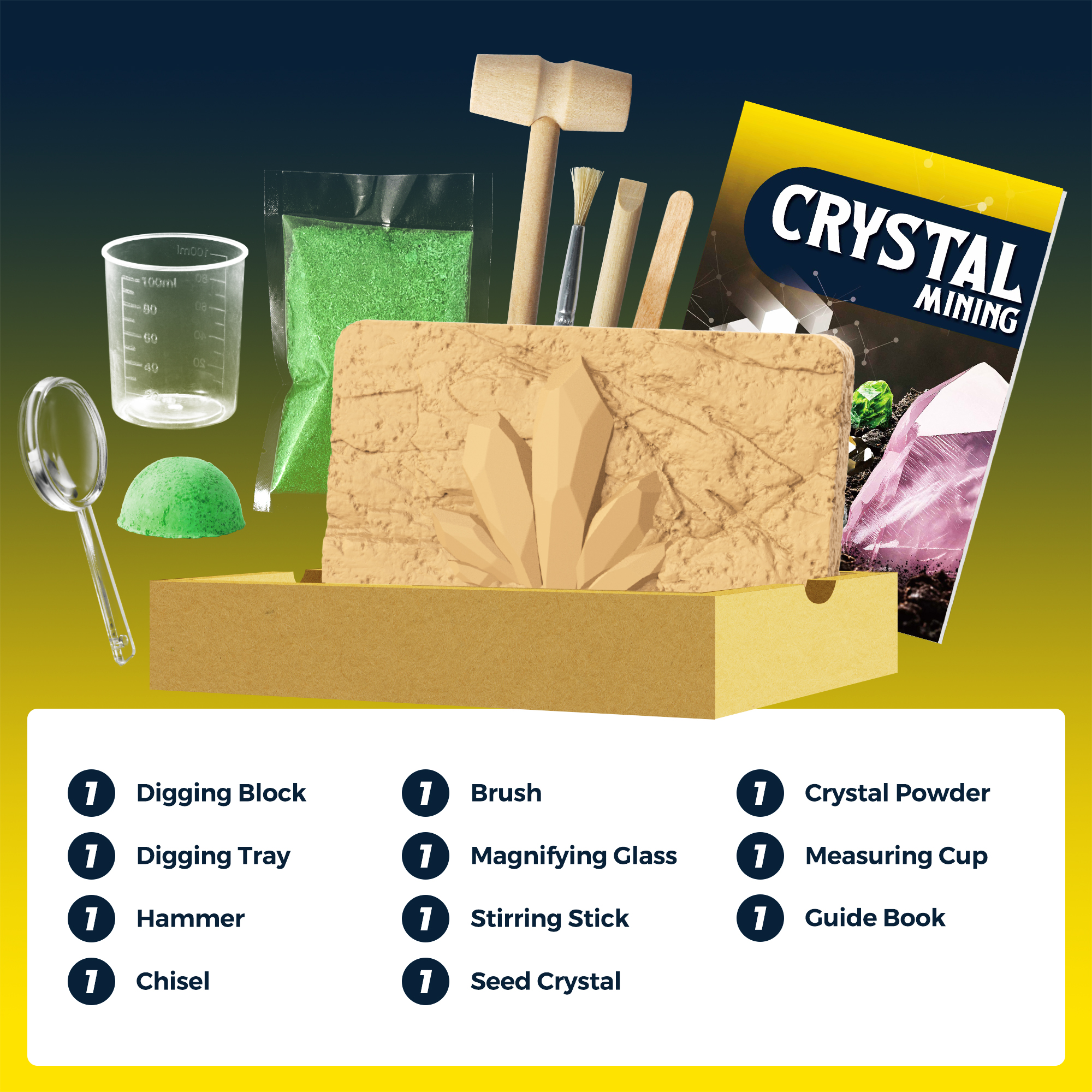
Toddlers aged 18 to 30 months stayed with a toy for 117 seconds and came up with 11 ways to play when the room held 4 toys. A room with 16 toys cuts both numbers, to 56 seconds and 7 ways[1]. The 30 usable experiments in that 100-experiment kit spread over 12 weeks give 2 or 3 a week.
No toy for under-3s may contain a part that fits entirely inside the small parts test cylinder[2]. Of the 519 batches of children’s toys checked in China’s 2025 national spot inspection, 60 failed, an 11.6% rate, and 60% of those failures were mechanical or physical[3].
What each type sells
Multi-experiment kits sell by the count
Boxes carry printed counts from 20 to 200 or more. Each experiment is squeezed into 5 to 15 minutes, so 100 of them add up to 8 to 25 hours.
The supplies are single-use. A bag of baking soda, a bag of citric acid and four droppers are finished after two or three runs. Most brands do not sell refills, so one missing bag means buying the whole kit again for 30 to 200 yuan.
About 70 of those experiments want supplies you already keep in the kitchen, things like vinegar, salt and baking soda, which is the part a starter box rarely ships with. Another 60 to 70 repeat the same reaction with a different colour. The two lists overlap heavily, so the deductions do not add up to 130 or 140.
Single-theme kits sell by the material
Crystal growing, microscopes, circuits and insect habitats cost between 60 and 400 yuan, and the consumables come separately. Crystals take 3 to 7 days from mixing to forming, so eight runs of the same recipe stretch across 24 to 56 days.
A microscope set with 400x total magnification costs around 300 yuan. That is three 100-yuan multi-experiment kits. Used once a week it lasts 52 weeks, and spread over five years that is 60 yuan a year. The multi-experiment kit’s 30 experiments, at 2 or 3 a week, are done in 12 weeks.
ISO 8124-10:2023 covers chemistry sets, crystal growing sets, carbon dioxide generating sets and refills. Its scope states, in translation[4].
This document does not apply to combined sets, for example a combined chemistry set and crystal growing set.
China’s GB/T 6675.9-2025 copies that exclusion. It was published on 31 December 2025, takes effect on 1 November 2026 and replaces GB 26387-2011[5]. An all-in-one box that crams chemistry and crystal growing together and claims 100-plus experiments sits outside both scopes.
What one experiment really costs
The printed count does not hold up
Seventy of the 100 experiments in a typical manual want vinegar, salt, baking soda, cooking oil, sugar or water, and some want a fridge or a microwave. The supply list from customer service is where those are itemised. Removing them and the repeats leaves 30, about a third of what the box promises.
Thirty experiments at 5 to 15 minutes each run 150 to 450 minutes, or 2.5 to 7.5 hours. Spread over 12 weeks that is 12 to 38 minutes of hands-on time a week.
Home supplies change the math
Vinegar, salt and baking soda at supermarket prices add 20 to 60 yuan across a whole kit. If your kitchen is already stocked, count that as zero.
A 100-yuan kit plus 40 yuan of supplies divided by 30 experiments is 4.7 yuan each. That is 3.7 yuan above the 1-yuan sticker price. A 120-yuan crystal growing kit run eight times gives 15 yuan a session. The kits-versus-loose-supplies question runs on the same arithmetic, and the answer turns once one kit gets used 20 times and the other 5.
| Item | Multi-experiment kit | Single-theme kit |
|---|---|---|
| Typical price band | 30 to 200 yuan | 60 to 400 yuan |
| What sets the price | The printed experiment count | Equipment and reagent volume |
| Real content | About a third of the printed count | One set of reagents usually covers 8 to 52 runs |
| Time per experiment | 5 to 15 minutes | 20 to 40 minutes, and crystals span 3 to 7 days |
| Consumables | Single-use, mostly not sold separately | Sold separately, reusable |
| Cost per use | 100 yuan for 100 experiments is 1 yuan, and 30 experiments is 3.3 yuan | A 300-yuan microscope over 52 runs is 5.8 yuan |
How many times will it get used
Researchers at the University of Toledo put 36 toddlers aged 18 to 30 months in a room with either 4 toys or 16 toys, and watched each child for 15 minutes. With 4 toys, the children switched activity 9.8 times. With 16 toys that doubled to 19.6[1].
A real experiment needs 3 to 10 minutes before anything shows. That is 3 to 11 times longer than the 56-second stop the 16-toy room produced. The sample was 36 children, 27 of them girls, almost all white, in a controlled room, all under 30 months. None of it transfers to school-age kids.
A session runs better with 2 or 3 materials on the table and a fresh batch the next week, which is easier to keep to in a corner set aside for the purpose. At the study’s pace of 19.6 switches per 15 minutes, a child moves on every 46 seconds. All 30 experiments laid out on a table get flipped through in 23 minutes.
Where the learning comes from
Hands-on is not the same as learning
The US National Academy of Sciences’ 2012 Framework for K-12 Science Education asks for science and engineering practices, crosscutting concepts, and disciplinary core ideas to appear together. It names 8 practices and 7 crosscutting concepts, and it puts depth ahead of breadth, the line that runs between open-ended play and step-by-step kits[6].
100 experiments that only list steps leave a child with 100 memories of doing something and 0 conclusions they can explain back to you.
Kits that only give steps
The National Research Council’s 2005 America’s Lab Report went through high school science labs, and it named the problem with recipe-style work[7].
When curriculum developers or teachers aim for guaranteed results, they are less likely to design or carry out the investigation with clear learning goals in mind.
Those activities do lower the odds of a student reaching a conclusion that clashes with accepted science. The price is that higher-level goals never get reached.
The report’s alternative was to fold labs into lectures, reading and discussion. Its AP biology osmosis sequence runs 6 to 7 class periods of 45 minutes, or 270 to 315 minutes, split across 5 experiments at 54 to 63 minutes each.
A 30-experiment manual built on the one-question-and-one-review rule should carry 30 questions. One that only lists steps carries 0.
Safety is not negotiable
Some 206,400 toy-related injuries were treated in US emergency rooms in 2021. Scaled by age group, that is roughly 152,700 for children 14 and under, 142,400 for 12 and under, and 76,400 for 4 and under. Across the year that is about 565 cases a day[8].
Reading the age label
The under-3 line is written as a measurable rule in US 16 CFR 1501, which states, in translation[2].
Any toy or children’s article subject to this part, tested by the method described in this part, must not be small enough to fit entirely inside the cylinder shown in Figure 1.
That cylinder is 31.75 mm across and 57.1 mm deep, about 45 ml in volume, and its diameter is 1.3 times a 1-yuan coin at 25 mm. Any part that drops in whole fails. Abuse tests for pull, twist and drop come next, and anything that breaks loose gets measured against the cylinder again.
The CPSC’s Age Determination Guidelines, revised in 2020, grade a product against what children at that age can actually do. Age grading also sets how hard the mechanical and chemical testing gets, and toys for under-8s are expected to survive that age group’s real use and misuse[9].
Toy safety standards cover children’s toys for under-14s. Anything powered adds electrical requirements, and 8 of the 60 failures in the 2025 inspection were electrical, or 13%[10][3].
The extra hurdle for chemistry kits
ISO 8124-10:2023 caps how much of each controlled substance a set may hold, and in some cases how concentrated it may be. It also requires labelling, a contents list, instructions, goggles and a minimum set of equipment[4].
China splits the same ground across GB/T 6675.9-2025 for chemistry experiment toys and GB/T 6675.13-2025 for other chemical sets. Both are recommended standards, which puts them a level below the mandatory GB 6675.1 through GB 6675.4, so they do not gate market access[11].
ASTM F963-23 leaves out hobby, craft and model kits whose main value is not play[12]. A box labelled teaching aid or laboratory apparatus, with the word toy nowhere on it, may fall outside toy safety rules entirely, because US rules define a children’s toy by the way it is intended to be used[13]. Buying for a child under 14 means checking it against teaching-aid standards instead.
Small parts, magnets and coin batteries
Shanghai’s market regulator tested 19 batches of magnetic putty and found magnets in every one, all classified as small parts. Flux indices measured between 886.9 and 1725.3 kG²mm², or 17.7 to 34.5 times the limit[14].
GB 6675.2-2014 draws that line at 50 kG²mm². No toy for under-14s may contain a magnetic part above it that is also a small part[14]. Two or more magnets can pull together through intestinal walls, and in extreme cases that means perforation or a blockage. The US handles magnets with a separate federal standard layered on top of the general toy rule[15].
Kits with LEDs or small motors bring the battery compartment into play. Since October 2023, US rules require a coin battery compartment to open only with a tool or two simultaneous hand movements, aimed at children 6 and under[16]. Toys that comply with 16 CFR 1250 are exempt, because ASTM F963’s own section 4.25 already covers compartments[12].
Slimy materials and smell
Boron migration in slime, putty and modelling clay is capped at 300 mg/kg under the recommended standard GB/T 39498-2020[17]. Against that line, a sample measuring 4170 mg/kg is 13.9 times over, which is 3.87 g more boron per kilogram of material than the limit allows[18].
Shanghai’s September risk monitoring took 40 batches of putty toys and found 13 non-compliant, a 32.5% rate. Sample prices went from 2.25 to 129.9 yuan, and the problems clustered at the cheap end[19]. Shanghai’s 2025 provincial spot check put the overall failure rate at 7.3%, down from 12.3% in 2024[20].
CCTV sent four slime samples to a lab. Boron migration came back at 1589, 2527, 5075 and 5712 mg/kg. The worst one was 19 times the limit, and the median of 3801 mg/kg was 12.7 times[21].
Seven crystal slime samples all contained boron. Another sample carried 1 mg/kg of hexavalent chromium, 50 times the 0.02 mg/kg limit for lightweight clay[18]. Borax poisons an adult at 1 to 3 g, and 5 g can kill a child[21].
GB 6675.4-2025 adds boron limits for modelling clay and putty, which until now leaned on that recommended 300 mg/kg[22].
The package carries the standard number. Before 1 November 2026, a 2014 number is normal. After that, production should carry the 2025 version. The CCC mark, the Chinese manufacturer’s name and address, and the age range fill in the rest[19][23].
A US buyer asks for a certificate of compliance alongside that paperwork, and the testing behind it has to come from a third-party body[24][25].
| Item | Limit | In everyday terms |
|---|---|---|
| Small parts test cylinder[2] | 31.75 mm across, 57.1 mm deep | About 45 ml, and 1.3 times a 1-yuan coin in diameter |
| Magnetic flux index[14] | No more than 50 kG²mm² | Tested samples ran 17.7 to 34.5 times that |
| Boron migration[17] | No more than 300 mg/kg | The worst sample tested at 19 times that |
| Lead in paint[26] | No more than 90 ppm | At most 9 mg per 100 g of coating |
| Total lead in substrate[26] | No more than 100 ppm | At most 10 mg per 100 g of material |
| Phthalates[27] | No more than 0.1% each | That is 1000 ppm, or at most 1 g per kilogram of plastic |
| Coin battery compartment[16] | Needs a tool or two simultaneous hand movements | Aimed at children 6 and under |
Rules that are about to change
Parts 1 through 4 of GB 6675 are mandatory national standards, published on 5 October 2025 and effective on 1 November 2026. That is 13 months, all four on the same day, with no phased rollout[11].
The EU replaced Directive 2009/48/EC with Regulation (EU) 2025/2509, which takes effect on 1 January 2026 and applies fully from 1 August 2030, a transition of four and a half years. Bans now stretch to endocrine disruptors, skin and respiratory sensitisers, PFAS and bisphenols, and every toy sold in the EU needs a digital product passport you can scan[28][29].
In the US, ASTM F963-23 has been mandatory since 20 April 2024, replacing F963-17. Two final rules issued on 12 December 2025 added water bead requirements to that standard, applying from 12 March 2026[10], and set separate requirements for neck floats from 15 June 2026.
When to pick a multi-experiment kit
A first kit suits a child with no clear favourite subject. Thirty to 200 yuan tests a direction, roughly half what single-theme kits charge at 60 to 400 yuan.
Plastic and electric toys, which is where cheap multi-experiment kits sit, improved the most. Shanghai’s failure rate across children’s products fell 5 percentage points from 2024 to 2025, a 41% drop, with those two categories down more than 10 points[20].
Your child reads diagrams and follows steps alone, and is 8 or older. You already own a magnifier, beakers and goggles, so the kit only tops up consumables and that 20 to 60 yuan of supplies falls close to zero.
When to pick a single-theme kit
Your child keeps asking about one thing, like how crystals form or what things look like under a microscope. Most single-theme reagents and consumables, crystal growing supplies included, are sold separately, usually around 10-plus yuan a pack, so the subject stays refillable.
Sixty-four microscope runs take about 1 year and 3 months. A 120-yuan crystal kit reaches 4.8 yuan a session at 25 runs, which at 3 to 7 days a round is 75 to 175 days.
A younger sibling under 3 changes the setup. Small parts, magnets and chemicals all need a locked cabinet, and an over-limit magnetic part is a risk for anyone under 14. Crystal growing and insect habitats come with fewer and smaller parts.
Common questions
Can a 3-year-old use a chemistry kit
No. Toys for under-3s may not contain a part that fits completely into the small parts cylinder, and the droppers, stoppers and measuring spoons in a chemistry set all qualify[2].
Does a 100-experiment claim mean 100 experiments
About 30 are genuinely different, under a third of the claim. The rest are home-supply items and the same reaction in another colour.
Can I buy a science kit secondhand
The equipment, yes. The reagents, no. Loose powders change hands with no record of how they were stored or how old they are. A secondhand box gets sorted on arrival. Chipped glass, warped plastic measures and caked powder go out, and the rest keeps working.
How long does an adult need to sit with it
Thirty experiments at 5 to 15 minutes are 2.5 to 7.5 hours. Prep, cleanup and talk-through bring an adult’s total to 5 to 15 hours, or 25 to 75 minutes a week across 12 weeks.
Are the goggles in the box enough
The standard requires the set to include goggles and a minimum equipment list[4]. Gloves are not a general requirement. Powders call for a pair of nitrile gloves bought separately, and a box of 100 usually costs a bit over 10 yuan.
Numbers to check before you buy
- Cost per usable experiment. A 100-yuan kit at 30 experiments is 3.3 yuan, or 4.7 with 40 yuan of supplies. A single-theme kit costs 5.8 to 15 yuan a session, and the extra buys repeatability and refills.
- Total hours of use. Thirty experiments at 5 to 15 minutes are 2.5 to 7.5 hours. A microscope at 52 sessions of 20 to 40 minutes is 17 to 35 hours, about five times more.
- Compliance items. The year in the standard number, the CCC mark and the age range have to line up, and under-3s need the small parts rule respected.
The numbers above are for buying one kit at a time. Buying for a store, a school programme, or your own brand runs on different figures. Send the age range, the experiments per box, and the market you sell in, and a shortlist comes back with the test reports and standard numbers that market asks for.
Request a quote
Sources and method
Every numbered figure for limits, dates and batch results comes from the list below, and each link opens for checking.
These judgement calls carry no citation. Printed experiment counts of 20 to 200 or more, multi-experiment kits at 30 to 200 yuan, single-theme kits at 60 to 400 yuan, and 20 to 60 yuan of pantry supplies are order-of-magnitude figures.
So are 5 to 15 minutes per experiment, 2 to 3 runs per supply bag, 3 to 10 minutes before an experiment shows a result, one question and one result review per experiment, roughly 10-plus yuan for a refill pack, and 10-plus yuan for 100 nitrile gloves.
Several figures come from dividing or converting the article’s own data. The list covers 1, 3.3, 3.7, 4.7, 4.8, 5.8, 15, 20, 30 and 60 yuan, plus 11.6%, 13%, 41%, 6x, 12.7x, 3.87 g, 45 ml, 3801 mg, 64 uses, and the case counts of 152,700, 142,400, 76,400 and 565 a day.
Time and count conversions follow the same route. They cover 8 to 25 hours, 2.5 to 7.5 hours, 17 to 35 hours, 12 to 38 minutes, 25 to 75 minutes, 5 to 15 hours, 46 seconds, 23 minutes, 25 runs, 75 to 175 days and 30 questions.
The 13.9x, 19x, 17.7x to 34.5x and 50x figures follow the original reports and standard text.
The putty risk monitoring used 40 targeted batches while the provincial spot check sampled whole categories, so the two failure rates are not comparable.
- Dauch C, et al. The influence of the number of toys in the environment on toddlers’ play. Infant Behavior and Development, 2018
- 16 CFR Part 1501, Method for Identifying Toys Intended for Children Under 3 Years of Age Which Present Choking Hazards Because of Small Parts
- State Administration for Market Regulation, 2025 national spot inspection of 41 product categories including children’s and infant clothing
- ISO 8124-10:2023, Safety of toys — Part 10: Experimental sets for chemistry and related activities
- National Standards Information Public Service Platform, Safety of toys — Part 9: Experimental toys for chemistry and related activities
- National Research Council, A Framework for K-12 Science Education (2012)
- National Research Council, America’s Lab Report: Investigations in High School Science (2005)
- US Consumer Product Safety Commission, Agency Information Collection Activities (2023 toy injury estimates)
- CPSC Staff, Age Determination Guidelines (2020)
- 16 CFR Part 1250, Safety Standard for Toys
- National Standards Information Public Service Platform, search results for the Safety of toys series
- ASTM F963-23, Standard Consumer Safety Specification for Toy Safety
- 16 CFR Part 1500, Hazardous Substances and Articles: Administration and Enforcement Regulations
- People’s Daily app, “This viral toy failed inspection” (Shanghai market regulator magnetic putty risk alert)
- 16 CFR Part 1262, Safety Standard for Magnets
- 16 CFR Part 1263, Safety Standard for Button Cell or Coin Batteries and Consumer Products Containing Such Batteries
- National Standards Information Public Service Platform, Guideline for the Control of Key Chemical Substances in Consumer Products
- Baoding Municipal Ecology and Environment Bureau, “Are soft clay toys safe?”
- Shanghai Municipal Market Supervision Administration, Product Supervision Division, risk monitoring of putty toys (published via Shangguan News)
- State Administration for Market Regulation, Shanghai pushes ahead with the three-year action plan for children’s and student products
- Ruoqiang County People’s Government, “This stress toy contains toxic substances” (reprint of CCTV’s Finance Investigation)
- National Standards Information Public Service Platform, Safety of toys — Part 4: Migration of certain elements
- Certification and Accreditation Administration of the P.R.C. (CNCA, the authority behind the CCC mark)
- 16 CFR Part 1110, Certificates of Compliance
- 16 CFR Part 1112, Requirements Pertaining to Third Party Conformity Assessment Bodies
- 16 CFR Part 1303, Ban of Lead-Containing Paint and Certain Consumer Products Bearing Lead-Containing Paint
- 16 CFR Part 1307, Prohibition of Children’s Toys and Child Care Articles Containing Specified Phthalates
- European Commission, Stronger toy safety rules enter into force (December 2025)
- European Commission, Toys (Internal Market, Industry, Entrepreneurship and SMEs)