
Choose a chemistry set by its age label, actual ingredients, required techniques and adult role—not by the number of chemicals or the biggest reaction in a photograph. A good first project uses a clear, age-appropriate procedure and lets the child observe a result without handling heat or unfamiliar concentrated reagents. More advanced equipment is worthwhile only when the child and supervising adult can use it as instructed.
Editorial update: 10 October 2026. Piano Potato sells science and activity kits, including products linked in this guide. This is a source-based buying guide; it does not report independent hands-on comparison testing. Product details are attributed to listings, and hypothetical budgets and planning ranges are labelled as such.
Match the activity to the child and the setting
Age labels set a minimum for the particular product; they are not a guarantee of independent use. Look at reading demands, measuring skills, fine-motor control, ability to follow instructions and willingness to stop. Difficulty also depends on concentration, quantity, temperature, glassware and disposal—not simply how many ingredients are listed.
| Activity | What the child does | Adult role | Time to plan |
|---|---|---|---|
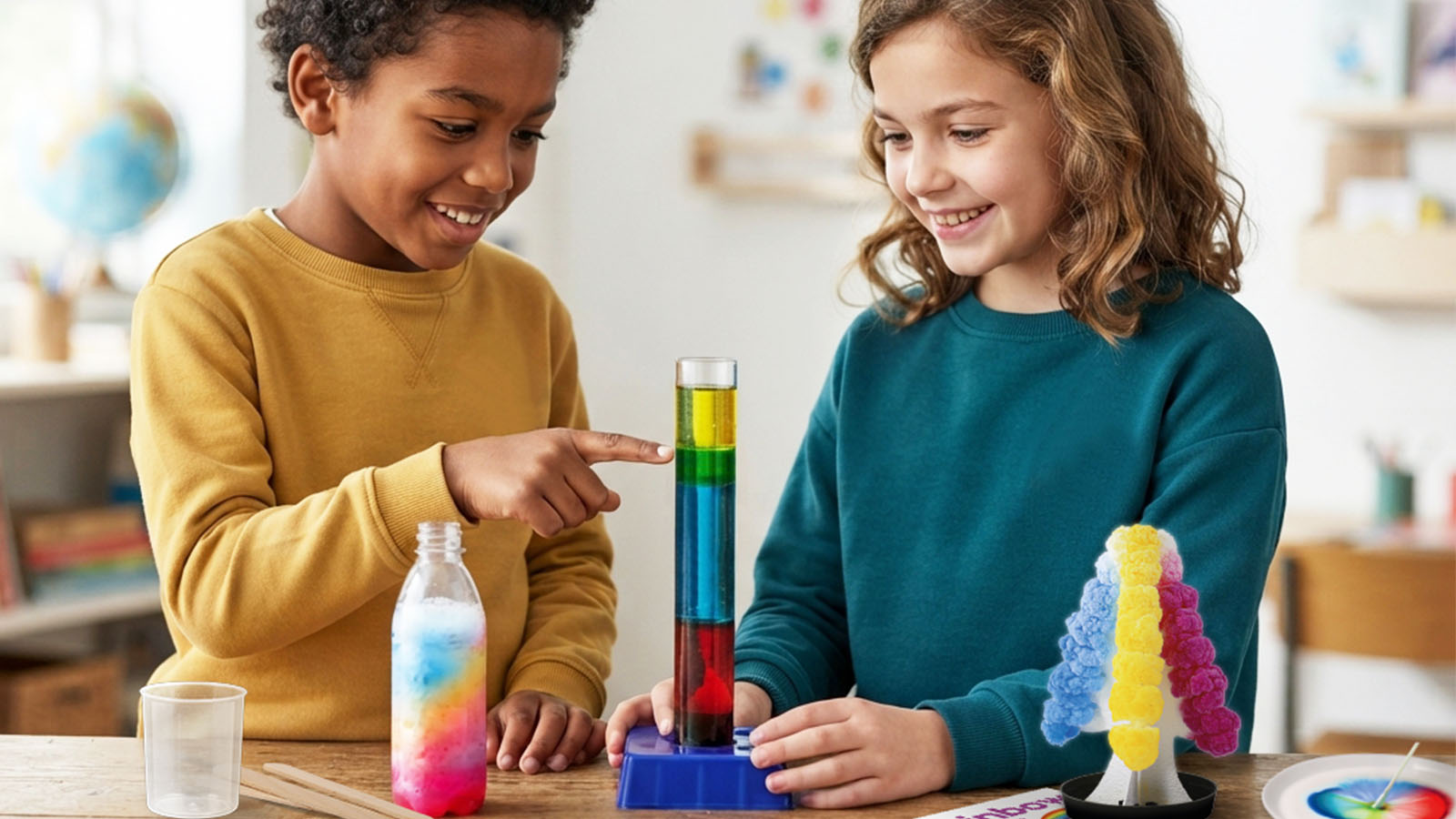
| Simple physical observations | Compare colours, floating objects or water movement using suitable materials | Select an age-appropriate activity and supervise | About 10–15 minutes of active work |
| Introductory chemistry | Measure specified small quantities, mix in an open container and record a change | Read the full procedure, prepare materials and supervise throughout | About 15–30 minutes, plus setup and cleanup |
| Multi-step reagent experiments | Follow labelled sequences and make comparisons | Check hazards, protective equipment, quantities and waste handling | About 20–40 minutes of active work, depending on the procedure |
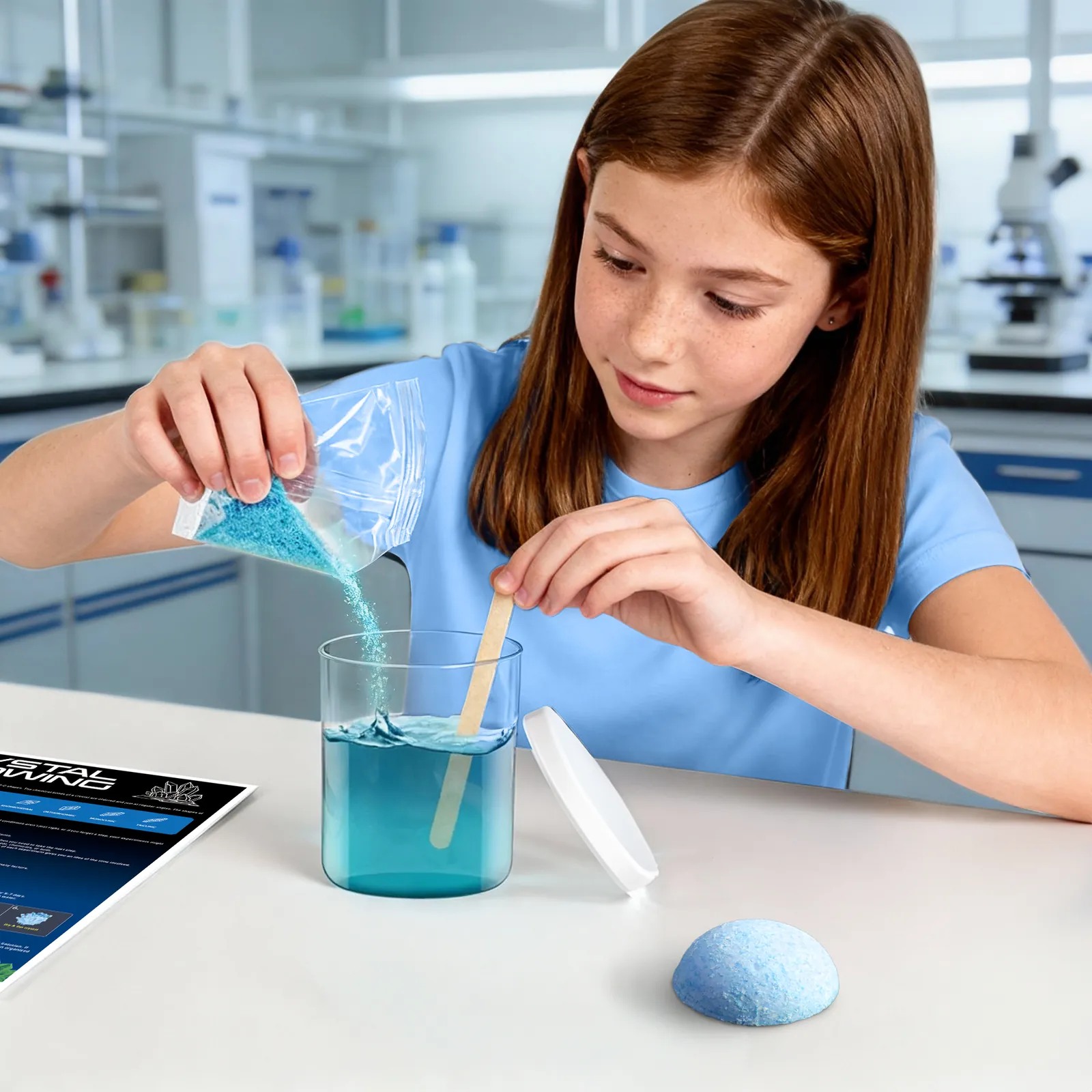
| Crystal growing | Observe and record growth after preparation | Handle adult-only hot-water steps and secure the growing container | About 15–30 minutes of preparation; growth may take days or weeks |
These bands do not authorise a preschool child to use an older-child chemistry kit. A short activity can be hazardous, and a long wait can be safe but inconvenient. A 0.1 g measuring requirement or a heating step is a reason to check the equipment and instructions, not an automatic age diagnosis.
Update the standard before quoting its limits
Standards status checked 10 October 2026: EU Implementing Decision 2026/2032 added EN 71-4:2020+A1:2025 to the harmonised list on 14 September 2026. The reference to EN 71-4:2020 is scheduled for withdrawal on 14 March 2028. EN 71-4:2013 should therefore not be presented as the current harmonised edition.[1]
A harmonised standard provides a presumption of conformity only for the requirements it covers. It does not, by itself, prove compliance with every obligation for the finished kit. The current EN 71-4 scope also excludes combined sets such as a chemistry set combined with a crystal-growing set; the supplier must establish the appropriate assessment for the actual product.[2]
What the older numerical limits actually mean
The previous version of this article quoted the following values from the publicly accessible 2013 edition. They are retained here as historical examples of how limits differ by set type, not as current purchasing specifications, recommended contents or instructions for an experiment. Current compliance requires the applicable edition and product-specific assessment.[3]
| Substance or requirement | Chemistry-set example | Crystal-growing-set example |
|---|---|---|
| Citric acid | 20 g per set | 50 g per set |
| Copper(II) sulfate | 15 g per set | 50 g per set |
| Aluminium potassium sulfate (alum) | 10 g per set | 600 g per set |
| Sodium hydrogen carbonate | 50 g per set | 600 g per set |
| Individual crystal-chemical packaging | Different packaging provisions apply | No more than 200 g in a container or package |
The 2013 text expresses relevant solid-substance limits on an anhydrous basis unless otherwise specified. That distinction matters when a hydrated salt is supplied. A larger total-set limit does not mean a substance is proportionally safer or that a child should use that amount at once. The same edition specifies an age marking not below eight for covered experimental sets and not below twelve for chemistry sets containing potassium permanganate. Those historical provisions are not a reason to add that substance to a home activity.
Three markets: different documents, not three universal age rules
| Market | Relevant checks |
|---|---|
| United States | Product-specific age grading, applicable toy and hazardous-substance requirements, and a CPC supported by required testing for children’s products. The chemistry-set exemptions in 16 CFR 1500.83 and 1500.85 are conditional, not blanket exemptions from safety rules. |
| European Union | Age and warning labels, applicable standards, conformity assessment, CE marking and declaration of conformity. Verify the standard edition and transition dates. |
| China | Applicable GB requirements and any required certification. GB/T 6675.9-2025 is scheduled to replace GB 26387-2011 on 1 November 2026; a recommended standard does not remove other mandatory obligations. |
Sources: CPSC toy guidance, 16 CFR 1500.83, 16 CFR 1500.85, European Commission toy-safety guidance, and the official Chinese standard record.
The EU Toy Safety Regulation entered into force on 1 January 2026 and generally begins applying on 1 August 2030. Do not confuse entry into force with the application date of its new product obligations. Similarly, the absence of a fixed age in a particular US exemption does not mean US sets need no age assessment.
Read both the contents list and the extra-supplies list
Check the chemical names, supplied quantities, concentrations where relevant, warnings, containers, equipment and disposal instructions. Obtain the actual manual before buying if the listing is vague. “Non-toxic,” “educational” and “all-in-one” do not replace this information.
- Liquids: do the instructions name the concentration, not just the chemical?
- Measurement: are the supplied tools suitable for the amounts used? Graduation spacing is not the same as a verified accuracy specification.
- Heat: is heating genuinely required, who handles it, and is the equipment specified for that purpose?
- Eye protection: is suitable, well-fitting protection available for both the child and supervising adult?
- Refills: are the exact approved replacements available, and how many complete activities can they support?
For example, the Glowing Crystal Grow Kit listing names two seed crystals, two powder bags and two growing cups, and its product-information table gives an age of 8+. Those are listing details, not an independent ingredient or safety verification. Two powder bags do not imply unlimited repeat growth; request the chemical identification and full preparation instructions.
Choose a question, not just a dramatic reaction
A first activity might compare dissolution under conditions specified by a trusted educational procedure, record a colour change, or observe crystal growth over time. Ask the child to predict a result, record what happened and explain one observation. Follow the quantities and permissible variations in that procedure rather than inventing substitutions.
For crystal growing, 3–7 days can be a useful first-week observation window if consistent with the kit’s instructions, but it is not a guaranteed completion time. Different substances, temperatures, evaporation rates and seed conditions can produce results over days or weeks. Photograph or sketch the container at the same time each day. Touching a crystal may disturb growth; it does not automatically reset a fixed clock.
A useful calculation, not a recipe: if vinegar contains 5 g of acetic acid per 100 mL, that is about 0.083 mol of acid. The theoretical neutralisation amount is about 7.0 g of sodium bicarbonate because the mole ratio is 1:1. Actual activities should use the small quantities specified by a vetted procedure. Gas production must not be confined in a sealed rigid container. Gas volume is not the same as foam volume, so it cannot alone determine the required cup size.
The American Chemical Society supplies children’s science activities and activity safety guidance. Prefer a complete procedure with a defined age group, materials, precautions and disposal instructions.
Protective equipment and supervision are part of the activity
For chemical splashes, use appropriately rated splash protection rather than assuming a toy pair of spectacles is sufficient. ACS elementary-classroom guidance recommends properly fitting splash-proof goggles when working with chemicals or observing such work. Gloves, if needed, must suit the substance and task; “nitrile for every powder” is not a universal rule.[11]
Prepare a stable, clear work area, keep food and drinks away, tie back hair, follow the instructions and wash hands afterward. The adult should stay able to intervene throughout. Reciting five safety rules, reaching a birthday or wearing goggles does not establish readiness for an unsupervised chemical experiment.
Never mix household cleaners or disinfectants into an experiment. CDC warns that bleach mixed with other cleaners can release dangerous vapours. Do not rely on a claimed “safe breathing height”: gas behaviour depends on ventilation and mixing, and anyone nearby can be exposed.[12]
Storage and disposal
Keep reagents in their original labelled containers with closures secured, in storage inaccessible to children and pets. A separate shelf is not automatically inaccessible; use locked storage when needed to prevent access. Store unfinished crystal projects securely as well. Child-resistant packaging is an additional protection, not permission to leave chemicals within reach.
Do not return experiment materials to food containers or put chemicals into drink bottles. Follow the kit’s substance-specific disposal directions and local requirements; do not assume every solution can go down a drain. Keep unknown or degraded reagents out of use and ask the supplier or local waste service how to dispose of them.
If an exposure occurs
Follow the product-specific first-aid instructions and contact a poison centre promptly. In the United States, Poison Control is available at 1-800-222-1222. Outside the US, use your local poison service; for an emergency in mainland China, call 120. If someone collapses, has a seizure, has trouble breathing or cannot be awakened, call the local emergency number immediately.
- Eyes: begin rinsing immediately with plenty of room-temperature water for at least 15–20 minutes; remove contact lenses if possible. Obtain poison-centre or medical advice.
- Skin: remove contaminated clothing and rinse immediately with running water for at least 15 minutes, then obtain substance-specific advice.
- Swallowed material: do not induce vomiting. Contact Poison Control promptly with the product, amount and time of exposure. Do not give anything by mouth to an unconscious, convulsing or swallowing-impaired person.
- Fumes: move to fresh air without entering an unsafe area and obtain urgent advice.
These steps are based on Poison Control’s first-aid guidance. Its advice about a small amount of water or milk after certain irritating or caustic ingestions is conditional on the person being conscious, not convulsing and able to swallow; it is not a universal instruction after any ingestion. Keep the container available for identification and do not wait for symptoms to request advice.
Budget for usable sessions
As an illustrative calculation, a CNY 60–300 kit used for 20 complete activities costs CNY 3–15 per activity before extras. These are budget inputs, not a surveyed price range or a promise that the included chemicals support 20 runs. Add refills, protective equipment and any required tools before comparing with DIY supplies.
Plan approximately 10–15 minutes for setup, 15–40 minutes for active work and 5–10 minutes for cleanup when the chosen activity fits those allowances. The total is 30–65 minutes, not invariably less than an hour. Keep crystal-growth waiting time separate.
Common questions
Can alum simply replace copper sulfate?
No. A separate, age-appropriate alum-growing activity may be a suitable alternative, but alum is not a gram-for-gram substitute in a copper-sulfate procedure. Solubility, crystal formation, quantities and handling differ. Use a procedure written for the actual substance.
Does a larger allowed chemical quantity mean an easier or safer kit?
No. A maximum supplied amount is a compliance parameter for a defined set type, not a toxicity ranking, difficulty rating or per-experiment dose.
What should I ask before ordering?
Request the age label, complete manual, chemical identification and quantities, adult-only steps, protective equipment requirements, refill options and product-specific compliance documentation. Then choose the simplest activity that answers the child’s question.
For a school or wholesale programme, send the target age, destination market, intended activities and quantity to request a current configuration and quotation.
Sources and evidence notes
Regulatory and research sources support the specific statements linked in the text; they do not certify or endorse the linked products. Product pages support attributed contents and price examples, not independent performance or safety findings. Planning times and hypothetical budgets are not laboratory measurements.
- EUR-Lex: Implementing Decision (EU) 2026/2032, harmonised standards and withdrawal date
- BSI: EN 71-4:2020+A1:2025, scope of experimental sets
- EN 71-4:2013: Historical edition, publicly accessible reproduction; not the current harmonised edition
- CPSC: Toy Safety Business Guidance
- 16 CFR 1500.83: Conditional labelling exemptions
- 16 CFR 1500.85: Conditional exemptions from banned-hazardous-substance classification
- European Commission: Toy Safety in the EU and the 2030 transition
- China official standards database: GB/T 6675.9-2025, effective 1 November 2026
- American Chemical Society: Science Activities for Children
- American Chemical Society: Science Safety Tips
- American Chemical Society: Safety in the Elementary School Science Classroom (PDF)
- CDC: Cleaning and Disinfecting with Bleach
- National Capital Poison Center: First aid for poisonings