

Choose a geode kit by the size and number of whole stones, the equipment needed to open them, and how you plan to keep the pieces. For a first kit, check the age requirements and opening instructions before paying extra for larger stones. For display, count the included stands; for matching halves, buy cut specimens rather than expecting an even hammer split.
This guide compares published product specifications and guidance from geological and eye-health organizations. It does not report hands-on testing. Product photos show the seller’s presentation, not guaranteed results from every stone.
Stone Sizes and Quantities
Look for measurements such as “3–5 cm along the longest side.” Package dimensions and the largest stone pictured do not describe the whole assortment. Ask whether the stated range applies to every geode.
| Listed Size | Approximate Metric Size |
|---|---|
| 1 inch | 2.5 cm |
| 1.5 inches | 3.8 cm |
| 2 inches | 5.1 cm |
| 3 inches | 7.6 cm |
| 5 inches | 12.7 cm |
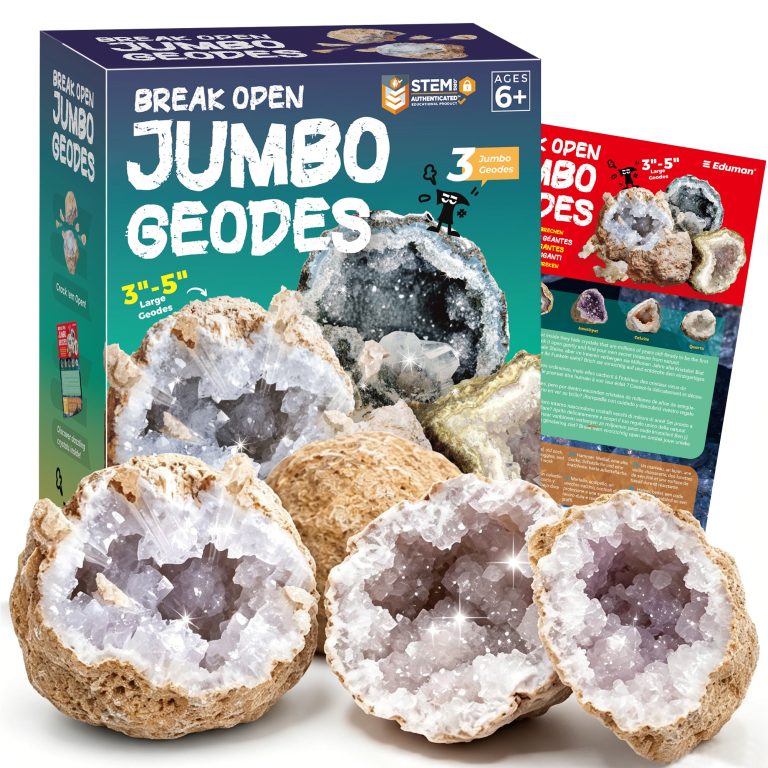
One inch equals 2.54 cm. The three-piece jumbo geode kit lists stones at about 3–5 inches each, or 7.6–12.7 cm. Those measurements are more useful than “jumbo,” but they do not establish how easily the stones will open.
Geodes vary in mineral filling. Some have little or no open space, and a bumpy exterior does not guarantee a hollow interior.[1] If your child wants a particular crystal appearance, choose an opened specimen with an actual-item photo.
- One opening attempt per child: Allow one whole geode each, plus any spares you want.
- Comparing interiors: Allow at least two specimens per child or group. Their interiors may still look similar.
- Sold by weight: Ask for the whole-stone count and individual size range before comparing prices.
A “20-piece kit” could contain six geodes, one pair of goggles, one magnifier, two stands, and ten record cards. Only six pieces are stones to open.
A gemstone dig kit usually involves removing material around embedded specimens. Check the contents if a listing uses “dig kit” and “geode kit” interchangeably.
Tools and Age Requirements
| Item | What to Check |
|---|---|
| Protective eyewear | Impact-protection markings, fit, quantity, and compatibility with prescription glasses. |
| Opening tools | The exact tools required, whether they are included, and who is permitted to use them. |
| Containment bag or guard | Whether the opening method requires one. A storage bag is not automatically suitable for containing fragments. |
| Magnifier | Whether the child can hold it steady and focus on a specimen, rather than the magnification number alone. |
| Instructions | The exact model’s age restrictions, supervision requirements, opening steps, and work surface. |
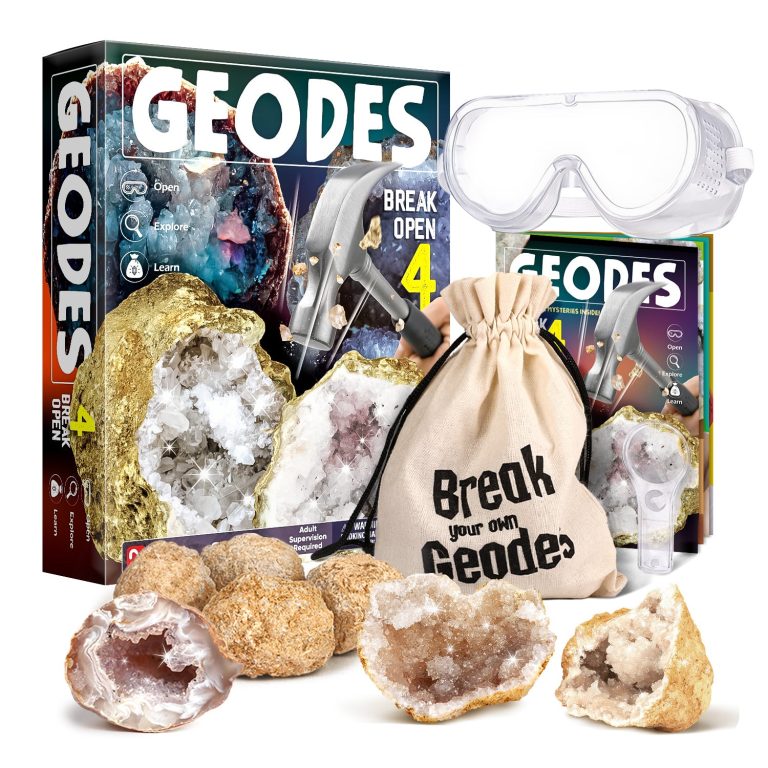
The four-geode kit lists goggles, a magnifier, a learning guide, a storage bag, and tools. Its description specifies ages 6+ with adult supervision. Since “tools” does not identify each item, request the full list before ordering.
Resolve conflicting age information before purchase. The jumbo kit’s title refers to ages 8–12, while its product image shows 6+. Ask the seller for the current package and instructions for the exact SKU; do not assume the lower age applies.
Eye Protection and Setup
Ordinary prescription glasses do not provide impact protection. The American Academy of Ophthalmology recommends ANSI Z87.1 protective eyewear for hazardous home activities; it must also fit the wearer and suit the task.[2] Do not assume included goggles meet these requirements without checking.
- Keep spectators away. The operator and any adult who must assist nearby need suitable eye protection.
- Use the work surface specified in the instructions and wear closed-toe shoes. Do not work on a glass table.
- Do not strike a stone held in a bare hand or have a child hold a chisel while another person swings a hammer.
- Do not add power cutting, drilling, or dry grinding. Stop and consult the instructions if a stone will not open.
Display and Storage
Display Stands
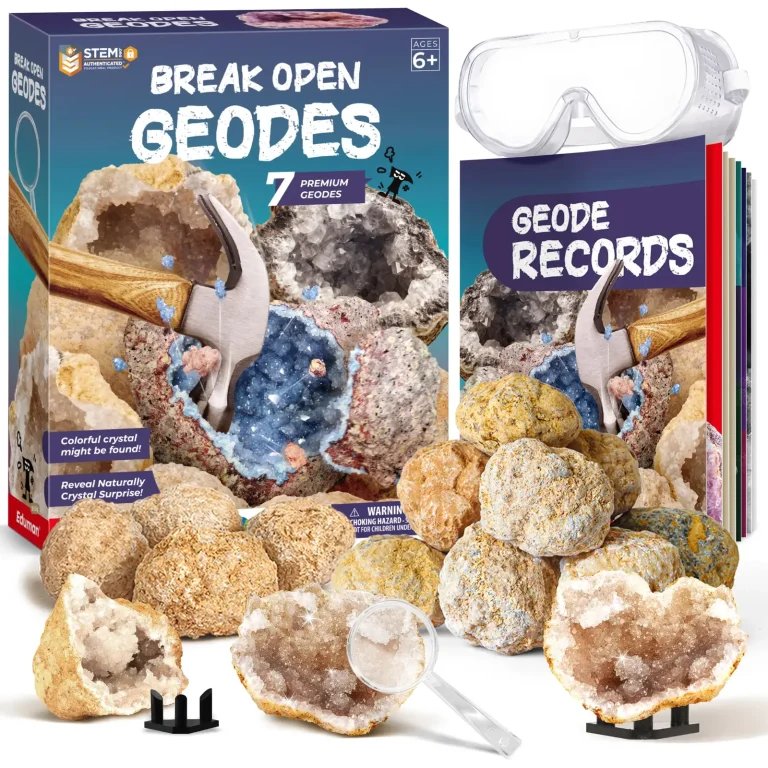
Measure and weigh the opened specimen before buying a stand. Check the support dimensions and ask about capacity for heavier pieces. The stand should hold the rock without tipping or pressing against crystal points.
The seven-geode kit lists two stands. You will need another place for the remaining pieces.
Divided Boxes
Choose the box after sorting the opened stones. Six geodes need 12 compartments if you keep two main pieces from each; hammering may produce more fragments.
A 5 × 4 × 3 cm specimen has 1 cm of total extra room in each dimension inside a 6 × 5 × 4 cm compartment. Padding reduces that space. Check that the lid closes without touching the stone.
Separate fragile pieces and pad them before transport. Keep small stones and sharp fragments out of young children’s reach; a regular box clasp is not childproof.
Matching Halves
Confirm that both halves come from the same geode and request a photo of the pair. A flat cut face can still have sharp edges, so ask whether the edges have been finished and check for loose fragments.
Price and Seller Checks
Compare kits within similar stone-size ranges. Add missing equipment, storage, and shipping before deciding which costs less.
For example, a CNY 90 kit that needs CNY 30 in extra supplies costs CNY 120 before shipping—the same as a CNY 120 kit that includes those supplies. These are hypothetical figures, not market-price estimates.
- Treatments: Ask whether the stones are dyed, coated, or otherwise treated. Photos alone cannot establish natural color.
- Reviews: Look for whole-order photos beside a ruler, reports of missing items, and comments about following the supplied instructions.
- Returns: Check how the seller handles incorrect sizes, missing parts, and failures to meet explicit promises such as hollow interiors.
Cleaning and Specimen Notes
Ask the supplier before washing unidentified, dyed, or coated specimens. For confirmed ordinary quartz geodes that the instructions permit you to wash, use clean water as directed and dry them before storage. Do not add acids or bleach.
Do not blow dust off stones, lick them, or place them in drinking water. Damp-wipe the work surface and wash hands afterward.
Sample Specimen Card
Specimen: G-03
Date opened: __________
Longest side: About 4.5 cm
Interior: Small white crystals around a small cavity
Mineral: Supplier identifies it as quartz; not independently confirmed
Write “unconfirmed” if the mineral is unknown. Identification uses several properties, including hardness, luster, and cleavage; white color alone does not establish that a specimen is quartz.[3]