
Choose a gemstone dig kit with named specimens, tools suited to the stated age group, and a guide that helps identify the finds. For a first dig, prioritize clear instructions and manageable tools. For collecting, check specimen sizes, condition, and treatment details. For group use, count separate blocks and tool sets—not just stones.
Specimen Quality
| Check | What Matters |
|---|---|
| Guaranteed contents | Look for a material list and a guaranteed count. “Up to 15 stones” does not promise 15, and assortment photos may show more than one box contains. |
| Variety | Check for duplicates and different names for the same mineral. More colors do not necessarily mean more mineral species. |
| Size and condition | Look for measurements or ruler photos, visible patterns, and intact crystal tips. Package dimensions do not tell you the size of the stones. |
| Materials and treatments | Check whether the assortment includes dyed stones, coated specimens, glass, resin, or plastic pieces. |
For example, five amethysts, five rose quartz pieces, and five clear quartz pieces give you 15 stones, but only one mineral species: quartz.[1] That assortment offers color comparisons, rather than a broad mineral collection.
The total may also include imitation pieces. The Earth Gemstone Dig Kit lists amethyst, green aventurine, pyrite, coral, and a blue plastic diamond-shaped piece. Its five finds are not five natural gemstones.
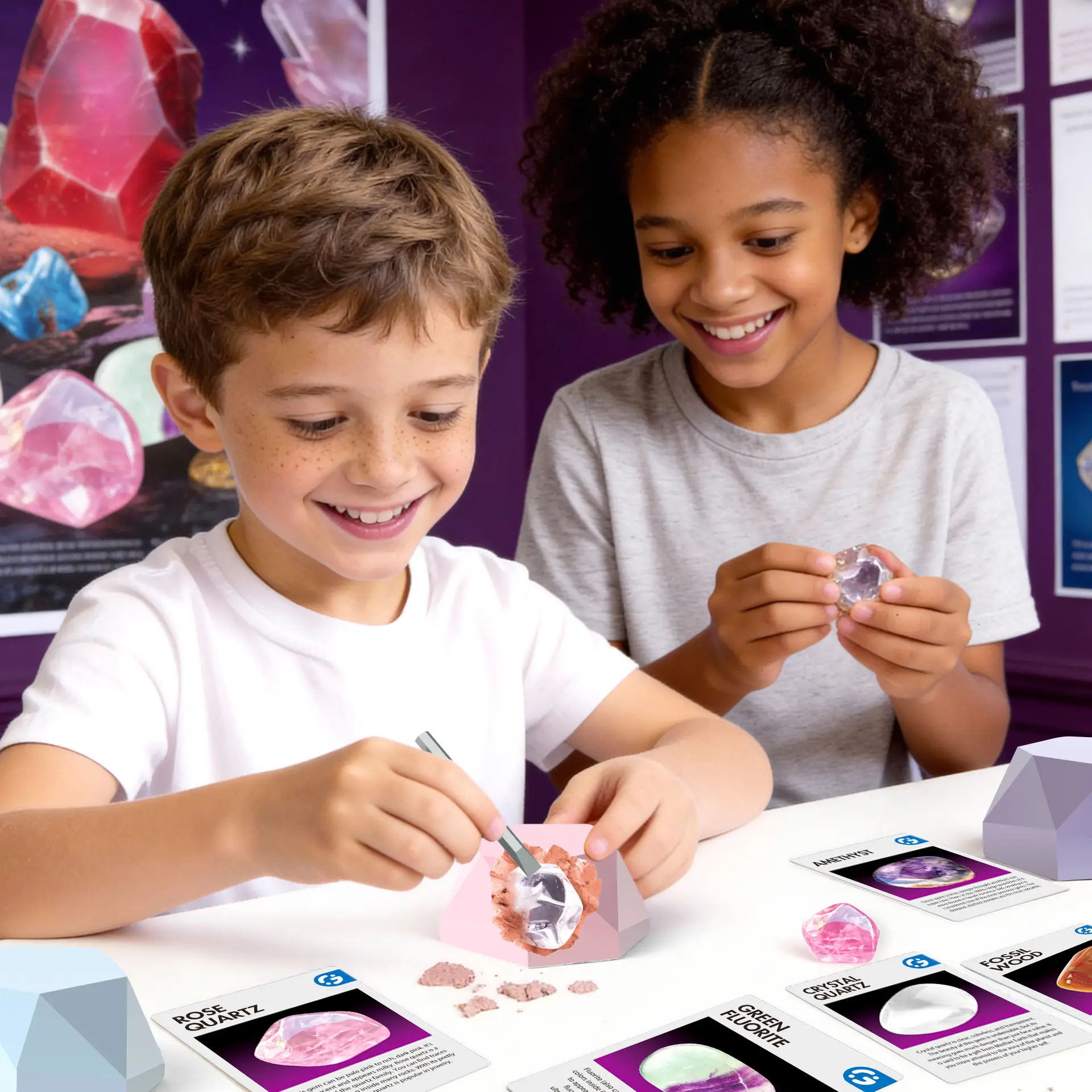
Digging Experience
Check for a digging tool and a cleaning brush. A “10-piece accessory set” may include stickers, labels, and bags, so read the itemized list. For group activities, four blocks and four tool sets allow four people to dig independently; two blocks and two sets require sharing.
Reviews for the exact model can reveal difficulty. Look for reports that the supplied tool cannot scrape the block, an adult must do most of the digging, or the block crumbles immediately. Check whether those users followed the water instructions before comparing their experiences.
Follow the kit’s instructions for dampening or soaking the block. Do not apply another product’s “soak for 10 minutes” advice. Permission to wet the block does not mean every recovered specimen can be soaked for cleaning.
For a first session, you could schedule 5–10 minutes for setup, 15–20 minutes for digging, and 10–15 minutes for cleanup. This 30–45-minute plan may cover only part of the block; it is not a tested completion time.
Age and Handling
Keep kits containing small stones or swallowable parts away from children under three. U.S. CPSC rules prohibit small parts in products intended for that age group when they present choking, inhalation, or ingestion hazards.[2] For older children, follow the age printed on the kit; adult supervision does not replace that requirement.
- Use eye protection as directed and work over a tray with raised edges.
- Do not blow dust away, eat while digging, or substitute heavy hammers or power tools.
- Collect debris and slurry rather than washing large amounts down the drain. Wash hands afterward.
Keeping the Collection
An identification guide should show names and distinguishing features, not just colored pictures. Amethyst and fluorite can both be purple, so color alone cannot settle the identification.[3]
If identifying and arranging stones is the main attraction, a ready-made set such as the 36-piece rock collection with an identification guide skips the digging stage. Compare its contents with specimens already owned before buying.
Label each find with an ID, its name and identification source, purchase details, size, and known treatment or origin. The kit’s manufacturing location is not necessarily the stone’s mining location.
G-01 | Amethyst, according to the kit label | Brand and purchase date | 20 mm long | Pale purple, partly transparent | Treatment and mineral origin unknown.
Check storage compartments by their internal length, width, and depth. A 30 mm stone needs room beyond a nominal 30 mm compartment so you can lift it out without catching a crystal tip.
If cleaning instructions are missing, gently brush off loose debris first. Do not assume soaking or household cleaners are suitable. GIA notes that alcohol or acetone can affect some dyes, while thin coatings are vulnerable to scratches.[4]
Price and Value
The following comparison uses hypothetical prices in Chinese yuan (CNY), not market averages.
| Feature | Kit A | Kit B |
|---|---|---|
| Price and count | CNY 80 for 20 stones | CNY 100 for 10 stones |
| Materials | Not listed | Five named varieties, all included |
| Specimen sizes | Not stated | About 1.5–3 cm |
| Identification and storage | Picture guide, no box | Identification cards and divided box |
Dividing the price by the stone count gives CNY 4 for Kit A and CNY 10 for Kit B. These figures include tools, packaging, and digging material—not just the stones. Ask for Kit A’s missing specifications before judging the difference, and add the cost of any supplies you would buy separately.