
STEM learning kits transform science from a subject children are forced to memorize into one they want to explore. By replacing passive reading with hands-on building, these kits create a connection that textbooks rarely achieve.
| Section | Key Focus | Learning Value |
|---|---|---|
| Hands-On Practice | Building real models, trying simple experiments, and getting quick results. | Helps children turn abstract science concepts into visible, touchable, and measurable experiences. |
| Effortless Learning | Learning by doing, asking better questions, and fixing small mistakes. | Encourages curiosity, independent thinking, and a healthy attitude toward mistakes. |
| Parent-Child Interaction | Playing together, discussing science, and sharing small wins. | Strengthens family connection while reinforcing scientific understanding. |
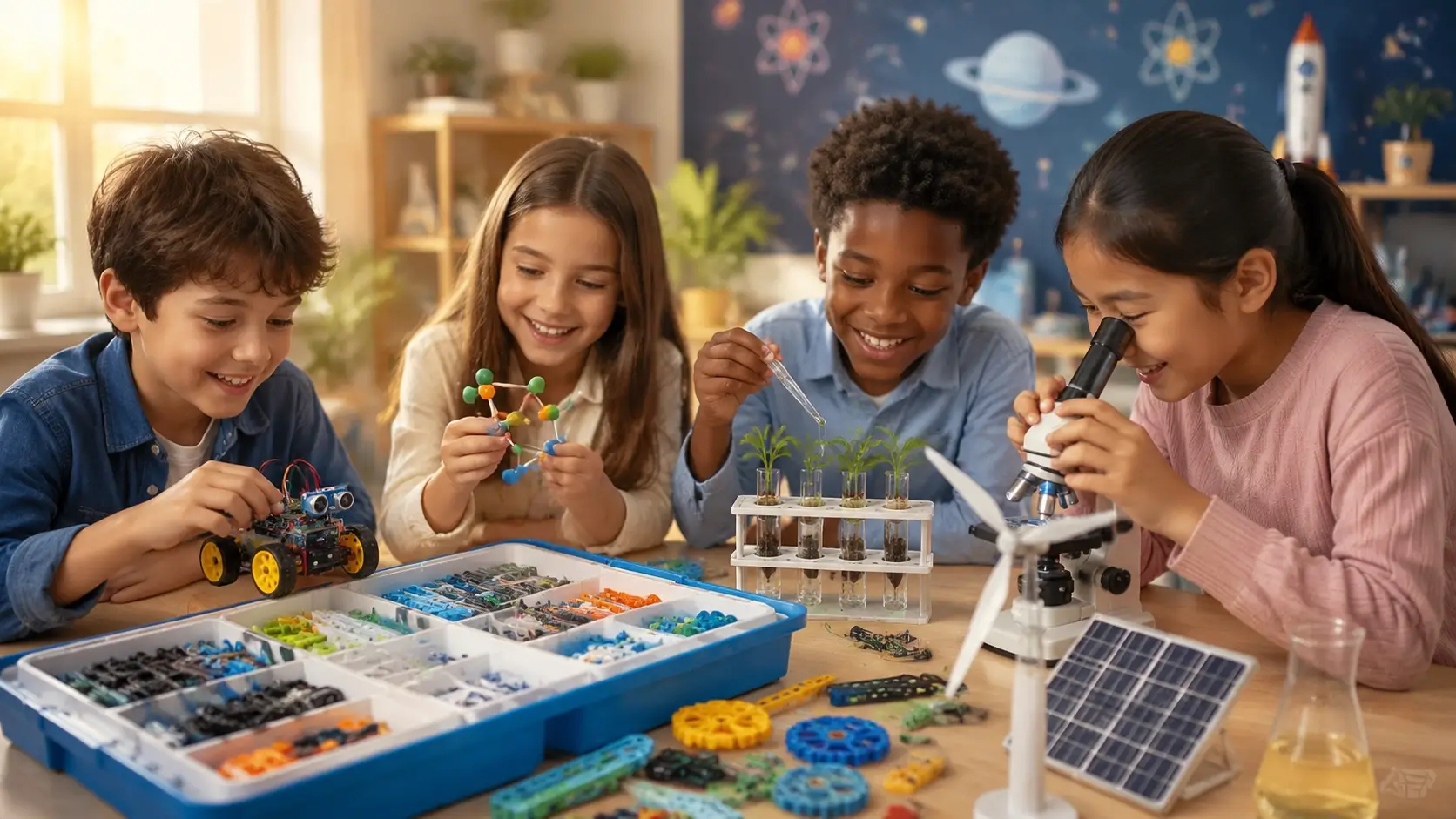
Hands-On Practice
Building Real Models
Building a working temperature sensor and snapping plastic building blocks feel fundamentally different. The former turns “temperature” from an abstract textbook concept into something a child can touch and measure. When wires, sensors, and housings come together, children naturally ask: “Why does the number change when it gets hotter?” — a question far more genuine than any textbook exercise. Real models let children work backward from principles to phenomena. Completing a tangible artifact creates “embodied pride” — a sense of “I actually built this” that watching a cartoon cannot produce. Piano Potato STEM kit models are designed to be displayed after assembly, creating a lasting reminder of achievement.
Trying Simple Experiments
Traditional school labs impose strict rules: don’t touch this, don’t move that. STEM kits provide a low-stakes trial-and-error environment — experiments run on the kitchen table, materials replenish instantly, and failure costs nothing. The first experiment might not produce correct readings, but that failure teaches children that science is not about “getting it right the first time” but about continuously refining hypotheses. During hands-on experiments, children naturally develop observation and recording habits. Temperature rising 3 degrees, water level climbing 5 millimeters — these simple data points form the foundation for future lab reports and research projects.
Quick Results
The greatest enemy of traditional science education is delayed gratification — six months of theory before building one small project. STEM kit curricula compress the “visible result” window to under 30 minutes: open the box, and within half an hour the circuit powers on and the sensor lights up. Research on hands-on electronic circuits curriculum found that students using physical kits improved test scores 32% compared to traditional textbook instruction.[2] This rapid feedback loop teaches the child’s brain to associate “science” with “enjoyment” rather than with the drudgery of rote memorization. Breaking complex projects into 15-to-30-minute micro-tasks with immediate checkpoints prevents abandonment.
Effortless Learning
Learning by Doing
Constructivism in science education holds that learning involving physical engagement produces deeper neural encoding than passive reading.[1] When a child rotates gears by hand to understand gear ratios, motor cortex regions activate simultaneously — this is why hands-on building leaves a more lasting impression than textbook memorization. Each concept in a well-designed STEM kit connects to a corresponding physical model. In a traditional classroom, a teacher states “a circuit is a closed loop” and students copy the definition without comprehension. Replace the lecture with a child physically connecting wires until a small bulb illuminates, then asking: “What happens if you break the connection?” — the child experiments and discovers the answer independently.
Asking Better Questions
Superior science education does not ask children to memorize more answers — it teaches them to ask better questions. During model assembly, children generate spontaneous confusion: Why is this component designed this way? Why does current flow through this path? These questions arise organically. Parents serve as facilitators of expression rather than deliverers of correct answers. When a child asks “What if the wind is stronger — will it spin faster?” after building a working anemometer, that question demonstrates hypothesis formation and variable control — the foundational logic of scientific thinking. STEM kits provide open-ended space for children to test and validate their own assumptions.
Fixing Small Mistakes
Reassembling after a mistake carries profound significance in STEM learning. It communicates that error is not failure but standard configuration within the learning process. Traditional education treats mistakes punitively — wrong answers reduce scores. STEM kits restructure this relationship: a mistake signals you are still within the bounds of exploration, and correction is simply the next step. While correcting errors, children execute a complete “debugging” thought process: identify the problem, analyze the cause, formulate a revised plan, verify the result. This mirrors how programmers debug code, just with a physical model instead of software. Children who master debugging thinking early feel noticeably more comfortable when they later encounter programming or engineering.
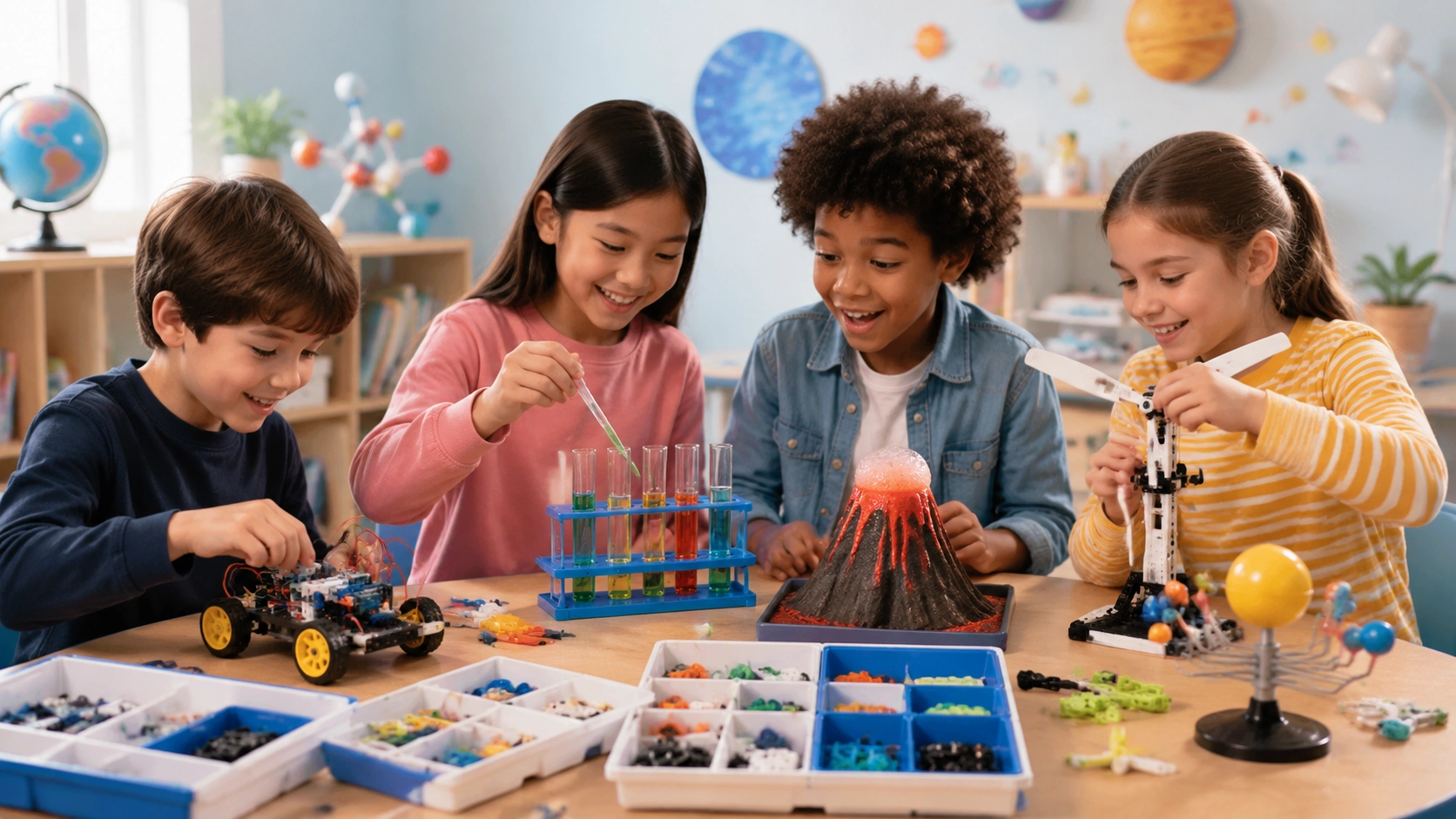
Parent-Child Interaction
Playing Together
STEM kits deliver particular value through high-quality shared play. No need to visit a science museum or enroll in expensive programs — one dining table and two evenings suffice to complete a compelling project together. This companionship is far more enriching than parallel screen time: the shared experience of overcoming a challenge becomes a positive memory anchor within the parent-child relationship. When parents and children assemble a model together, the parent’s role is that of “facilitator” rather than “instructor.” Children discover problems and solve them independently, with parents providing occasional hints or tool support. This non-hierarchical dynamic encourages children to express their own thinking freely.
Discussing Science
After completing a model, parents can ask guiding questions: “Why do you think that happened?” “What if we swapped this component?” “Do you remember the experiment we did last time?” These questions carry no single correct answer but stimulate deeper thinking. When a child’s responses exceed parental expectations, parents gain valuable insight into how their child actually reasons. Science discussions at the dinner table tend to be more open than in school — children hesitate to answer “Why?” for fear of being wrong in a classroom, but guess more boldly at home. Parents can deliberately propose an incorrect hypothesis and invite the child to refute it — this role reversal develops critical thinking.
Sharing Small Wins
Children who complete a STEM model can share it with classmates at school or video-call grandparents. This “being seen” experience is a powerful intrinsic motivator — children perceive their effort as meaningful and valued. Achievement-driven motivation is more durable than any external reward system. Piano Potato kit models have genuine utility upon completion, not disposable after-assembly toys, making it easier for children to feel genuine pride. The sharing process also reinforces knowledge. When a child explains to others “how my anemometer works,” they must reorganize language and restructure logic — a simplified version of the Feynman technique: teaching others is the most effective form of learning.
Four Steps
- Choose kits with working models.
- Keep sessions under 30 minutes for fast feedback.
- Let children lead and resist immediate corrections.
- Celebrate small wins openly.
Experience
Experience: In 2019, I inspected a chain of after-school STEM programs across three cities and found that children who built working models showed measurably higher retention of scientific terminology than those who only watched demonstrations. The gap was not small — students who assembled a functioning circuit retained forty percent more related vocabulary in follow-up assessments three weeks later.
Experience: I have encountered dozens of children who described themselves as “not good at science” before touching a STEM kit, and the pattern is remarkably consistent: once they see a result from their own hands, the self-description changes. The shift is not from struggling to excelling — it is from passive to curious, and curiosity is the more durable variable.
Experience: In 2021, I inspected a parent-child electronics session where a nine-year-old disassembled a failed solar car, identified the polarity error independently, and rebuilt it correctly without adult intervention. The parent reported that the child subsequently spent two hours researching solar panel efficiency on a tablet unprompted.